From the conversion glossary
Concepts referenced in this article, defined.
Concepts referenced in this article, defined.
Run rigorous A/B tests and personalize every visit on Shopify or any storefront — no engineers required.
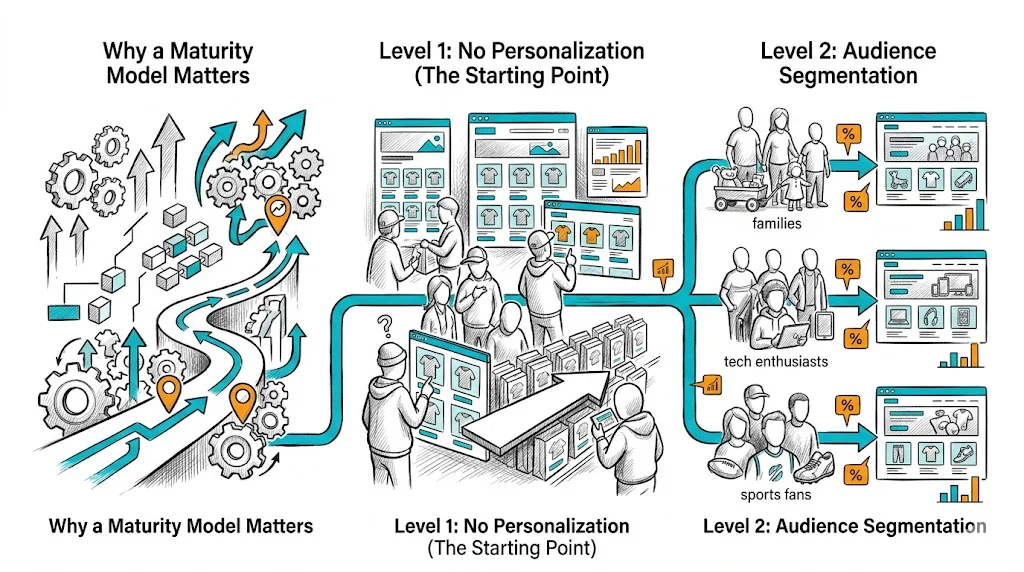
Personalization in ecommerce is not a single capability—it is a spectrum. The gap between showing the same homepage to every visitor and showing each visitor a page built around their browsing history, location, and purchase stage represents years of investment and infrastructure. Most D2C brands need not be at the top of this spectrum to see significant results. Understanding where you are and what the next level looks like is the foundation of a practical personalization roadmap.
Without a framework, personalization discussions tend toward extremes: either "we do not do any personalization" or "we want AI to personalize everything." Both miss the practical middle ground where most revenue improvement happens.
A maturity model:
Characteristics: Every visitor sees the same homepage, product listings, and messaging. The experience does not change based on who you are, where you came from, or what you have done before.
Who is here: Most early-stage D2C brands, brands that launched on marketplaces first, businesses running on themes with no personalization layer.
Impact on CVR: Baseline. No lift, no drag. But significant opportunity being left on the table.
What Level 1 misses: A first-time visitor and a customer who has bought three times before are shown identical experiences. A shopper who came from a Google ad for "vitamin C serum" and one who came from a WhatsApp link see the same homepage. This is a missed opportunity at every touchpoint.
Characteristics: Basic rules-based personalization. Different experiences for clearly defined, static segments.
Key segments at this level:
What changes: Homepage banner, hero headline, promotional offer, featured products. Simple if/then logic—"if new visitor, show welcome offer."
How to get here: CustomFit.ai makes Level 2 achievable without a developer. You define audience segments and create variant experiences—no code required. Set up in a few hours, not weeks.
Revenue impact: 5–15% CVR improvement is typical from well-executed Level 2 personalization. Showing a relevant welcome offer to first-time visitors or matching the landing page to the ad creative can move the needle measurably.
Who should be here: Any brand with >3,000 monthly sessions and a team member who can own personalization experiments. This is the minimum viable personalization level for a serious D2C operation.
Characteristics: Personalization based on on-site behavior—what the visitor has done, looked at, or engaged with during their current or previous sessions.
Behavioral signals used:
What changes: Product recommendations, category-level banner, upsell/cross-sell suggestions, urgency messaging on products they have viewed multiple times.
Example in action: A visitor who has viewed your sunscreen category twice but not added to cart sees a personalized banner: "Your skin deserves this—get 15% off your first sunscreen order." A visitor who bought face wash last month is shown complementary toners on the homepage.
Technology required: A personalization platform with session tracking and behavioral trigger support. CustomFit.ai supports behavioral targeting with its no-code interface, making Level 3 accessible without a data engineering team.
Revenue impact: 15–30% CVR improvement on targeted segments. Behavioral personalization shows the right product at the right moment—timing is a significant conversion variable.
Characteristics: Machine learning models predict what a user is likely to want, do, or buy based on aggregated behavioral patterns across your customer base.
What gets predicted:
What changes: Product ranking on category pages, personalized email content, homepage product grid, push notification timing.
Technology required: A CDP (Customer Data Platform) or ML-enabled personalization engine. At this level, you are integrating data across email, site behavior, purchase history, and potentially offline signals.
Who should be here: Brands generating ₹5 crore+ monthly revenue with a dedicated growth or data team. The complexity and cost of Level 4 are justified only at this scale.
Characteristics: Every element of the shopping experience is assembled in real time based on that specific user's complete profile—behavioral, transactional, contextual.
Examples: The exact product ranking, price display, offer, and content for each user is unique. Natural language product descriptions adapt to user preferences. Pricing and offers vary at the individual level based on willingness-to-pay models.
Technology required: Enterprise personalization platforms, significant data infrastructure, dedicated engineering. This is the territory of Nykaa, Myntra, and Meesho—brands with massive data and engineering teams.
Who should be here: This level is the aspiration for large-scale platforms. For most D2C brands, Level 3–4 is the practical ceiling and delivers excellent ROI.
From Level 1 to Level 2: Implement a personalization tool (CustomFit.ai, for example), define 2–3 key audience segments, and create variant experiences for each. Budget: ₹6,000–₹15,000/month in tooling. Time to first results: 2–4 weeks.
From Level 2 to Level 3: Add behavioral tracking to your personalization platform, define behavioral triggers (viewed 2+ times, added to cart but not bought), and create behavioral response campaigns. This takes 4–8 weeks to build proper segment definitions.
From Level 3 to Level 4: Invest in a CDP to unify your customer data, start building predictive models using your purchase history, and integrate model outputs into your personalization layer. This is a 3–6 month investment.
Related reading: Conversion Rate Optimization | A/B Testing | Customer Journey | Behavioral Targeting | Ecommerce Loyalty vs Acquisition
See also: D2C & Ecommerce Growth Pillar | Personalization Pillar