From the conversion glossary
Concepts referenced in this article, defined.
Concepts referenced in this article, defined.
Run rigorous A/B tests and personalize every visit on Shopify or any storefront — no engineers required.
Product photography is the closest thing your online store has to a physical product display—when a shopper can't touch, smell, or try your product, your images are doing all the sensory work. For Indian D2C brands, especially in the early stages, the quality gap between professional and amateur product photography is one of the most common conversion rate killers, and one of the easiest to fix. This guide covers everything from a ₹5,000 DIY setup to professional shoot direction, with a focus on images that actually convert, not just look nice.
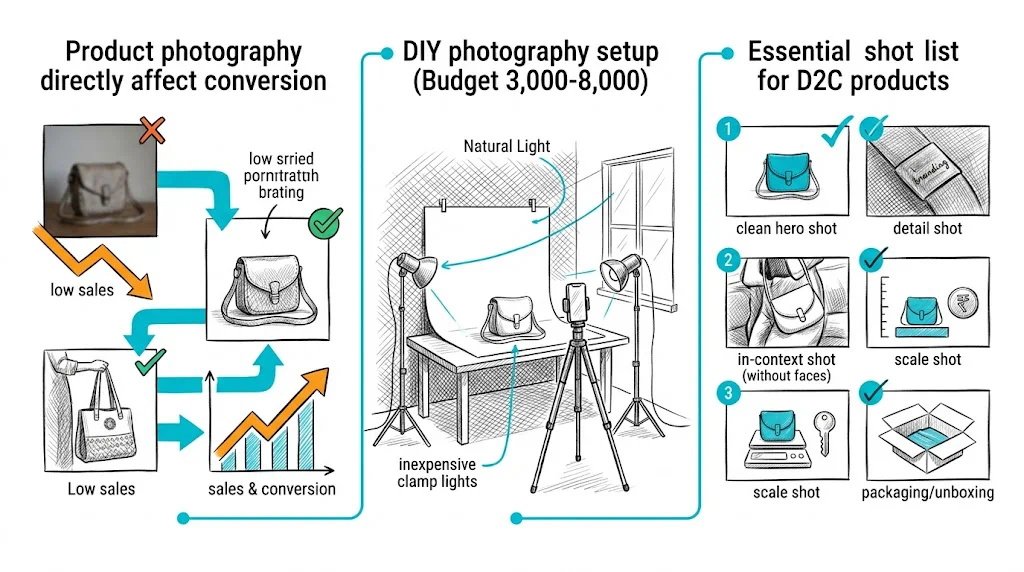
The correlation between image quality and conversion is direct and measurable. Shopify data across thousands of stores shows that product pages with professional-quality images convert at 30–50% higher rates than those with amateur photography, even when the product itself is identical.
The mechanism is simple: poor images create uncertainty. If a shopper can't clearly see what they're buying—the texture of a moisturiser, the actual colour of a dress, the build quality of a bag—they won't buy. The bounce rate on product pages with low-quality images is consistently higher than those with clear, detailed photography.
For Indian D2C brands, this matters because the marketplace competition (Amazon, Flipkart, Nykaa) sets the visual quality benchmark for your category. Your own website has to meet or exceed that benchmark to convert unfamiliar visitors.
You don't need a professional photographer or studio to produce conversion-quality images. The equipment needed:
Lighting (₹1,500–₹3,000): A ring light (40cm diameter, ₹1,500–₹2,500) or two desk lamps with daylight-spectrum bulbs (5500K) placed at 45-degree angles to the product. Avoid direct sunlight—it creates harsh shadows and unpredictable colour temperature.
Background (₹500–₹1,500): Foam core boards (white and black) from any stationery shop, ₹150–₹300 each. A sweep background (curved white board) eliminates the line between surface and backdrop. A vinyl backdrop sheet (₹800–₹1,200) enables quick background changes.
Surface (₹500–₹2,000): A light grey or white table surface for food and beauty. Marble-print contact paper (₹500) on a flat board creates a premium look. Wooden slats or craft paper work for lifestyle brands.
Tripod (₹500–₹1,500): Essential for consistency across shots. Wobbly hand-held shots look unprofessional regardless of lighting quality. A basic adjustable tripod costs ₹500–₹700.
Smartphone: Any flagship smartphone from the last 3 years produces sufficient quality. Enable RAW mode or Pro mode to control ISO, shutter speed, and white balance manually.
Total setup investment: ₹3,000–₹8,000 for equipment that lasts years.
Every product listing should include these image types:
Clean, sharp, centred product on pure white background. Required for Amazon, Flipkart, and Nykaa listings. Also works as the primary image on your own website. This image answers "what exactly is this product?"
Specifications: RGB 255,255,255 background, product occupying 80–85% of frame, no shadows or props, no text overlays.
Front, back, side, and top-down views depending on the product. For a supplement bottle: front label (primary), back label (ingredients), side angle showing size/form, cap close-up showing quality. For a clothing item: front, back, close-up of fabric/texture, detail shot of print or finishing.
Product shown in the context of actual use. A moisturiser on a clean bathroom counter next to a towel. Protein powder shaker beside running shoes and gym equipment. A dress worn by a model in a setting that reflects the brand's aesthetic.
Lifestyle shots answer "does this fit my life?" and are the highest-converting image type for social media discovery and Instagram ads.
Show the product next to a hand, a coin, or another familiar object to give shoppers an accurate sense of size. "10cm × 15cm" in a description is less intuitive than seeing a bottle held in a hand.
For beauty and health products, a close-up of the key ingredient (a saffron strand, an aloe vera leaf, a key capsule ingredient) visually communicates the product story. For fashion, a close-up of the fabric weave, stitching quality, or print detail builds perceived quality.
For skincare, hair care, and health products, before/after comparison photos are the highest-converting image type—but must be authentic. Use real customer photos with permission. Clearly label as "Customer results vary" to comply with advertising standards.
You don't need Photoshop. Free and low-cost alternatives work for most D2C photography:
Snapseed (free, mobile): Excellent for white balance correction, contrast adjustment, and minor blemish removal.
Lightroom Mobile (free basic, ₹749/month for full): Professional-grade editing on mobile. Create presets for consistent colour grading across all your product shots.
Remove.bg (₹500–₹2,500/month): Automatic background removal for white background shots. Essential for marketplace listing requirements.
Canva (free/₹3,999 year): For adding text overlays, labels, or feature callouts to marketing images (not for marketplace hero shots which require clean backgrounds).
Editing checklist for every product image:
Texture shots are critical—the closest possible shot of a cream on a finger, a serum dropping from a pipette, or a powder swatched on skin. These shots communicate what product descriptions cannot.
Include a model shot showing the product on Indian skin tones. The absence of Indian skin tones in product photography is a consistent criticism of Indian D2C beauty brands from their customers.
Lifestyle context shots perform best: supplement bottle on a kitchen counter next to a glass of water, powder in a shaker at the gym, vitamins in morning routine context. These create habitual use imagery that sells the outcome, not just the product.
Flat lays on clean backgrounds work for budget shoots; model shots perform better on actual product pages. If using model shots, ensure the model reflects the target customer's body type and skin tone.
Show fabric in motion where possible—a flowing dupatta, a structured blazer arm movement—to communicate texture and drape.
Natural lighting works best for food photography. Side or back-lighting creates depth and makes food look appetising. Show the product in its ideal consumption context: tea in a ceramic mug with steam, healthy snack bar next to hiking gear, cooking ingredient integrated into a completed dish.
DIY photography has limits. Hire a professional photographer when:
Budget for professional product photography: ₹5,000–₹20,000 for a full product shoot day (8–10 hours, 3–5 products, white background + lifestyle variants). In metros, expect the higher end; in Tier-2 cities, often 30–40% lower.