From the conversion glossary
Concepts referenced in this article, defined.
Concepts referenced in this article, defined.
Run rigorous A/B tests and personalize every visit on Shopify or any storefront — no engineers required.
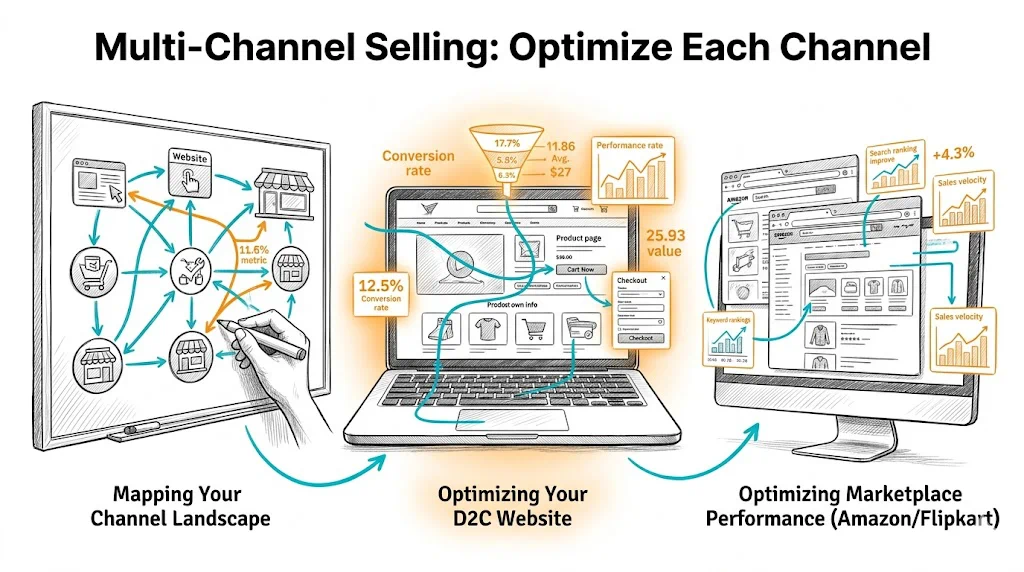
Selling across multiple channels—your D2C website, Amazon, Flipkart, quick commerce platforms, and WhatsApp—can multiply revenue, but it also multiplies complexity. The brands that grow profitably from multi-channel are those who treat each channel as a distinct business with its own customer profile, conversion mechanics, and optimization approach. Treating all channels the same leads to mediocre performance everywhere.
Indian D2C brands typically operate across some combination of:
Own website (D2C): Highest margin, full customer data, ability to personalize and run A/B tests. Conversion rate is typically 1.5–3% but can exceed 5% with strong CRO work.
Amazon/Flipkart: High traffic, trust, and discovery—especially for new customers. Lower margins after fees (15–30% commission). Limited ability to personalize or brand the experience.
Quick commerce (Blinkit, Zepto, Swiggy Instamart): Impulse-driven, fast delivery. Works best for consumables, personal care, and food. High dependency on platform ranking and availability.
WhatsApp Commerce: High conversion for existing customers. Works well for re-orders and exclusive drops. Requires active community management.
Instagram/Facebook Shops: Discovery-led. Conversion rates are lower but customer acquisition costs can be favorable for visually strong brands.
Each channel attracts different customers at different stages of their relationship with your brand.
Your website is the only channel where you control the full experience. Every optimization hour spent here delivers compounding returns through higher CVR, better LTV data, and direct customer relationships.
Conversion Rate Optimization priorities:
CustomFit.ai's no-code A/B testing lets you test each of these elements without a developer. Bellavita used this approach to achieve an 11% lift in conversion rate; Kapiva saw a 9.48% improvement.
Personalization levers unique to your D2C site:
On marketplaces, you compete on listing quality, reviews, pricing, and ad placement—not on checkout experience.
Listing optimization:
Reviews are your conversion rate lever on marketplaces. A product with 4.4 stars and 200 reviews converts dramatically better than the same product at 3.9 stars with 50 reviews. Build a post-purchase review request sequence and resolve negative reviews publicly and professionally.
Advertising on marketplaces:
Quick commerce (Blinkit, Zepto, Swiggy Instamart) has different optimization mechanics than traditional ecommerce:
Availability is everything. A product that goes out of stock during peak demand hours loses both the immediate sale and ranking. Work with platform account managers to forecast demand and maintain safety stock.
Images for quick commerce need to be legible at small sizes. People scrolling through a quick commerce app see thumbnails—make sure your packaging and product image communicates category and benefit at a glance.
Placement and ranking are driven by sales velocity, ratings, and compliance with platform content guidelines. Early-mover advantage in category placements is significant—brands that establish strong quick commerce presence during platform growth phases build durable position.
Bundling for quick commerce: Platforms favor higher-value orders. Create category-relevant bundles (e.g., face wash + moisturizer kit) that increase basket size and improve your ranking through higher GMV per order.
Channel pricing is one of the trickiest aspects of multi-channel selling:
Multi-channel selling requires careful inventory allocation to avoid stockouts on high-velocity channels and overstock on slow ones:
Related reading: Conversion Rate Optimization | Average Order Value | Customer Journey | A/B Testing | Ecommerce Loyalty vs Acquisition
See also: D2C & Ecommerce Growth Pillar