From the conversion glossary
Concepts referenced in this article, defined.
Concepts referenced in this article, defined.
Run rigorous A/B tests and personalize every visit on Shopify or any storefront — no engineers required.
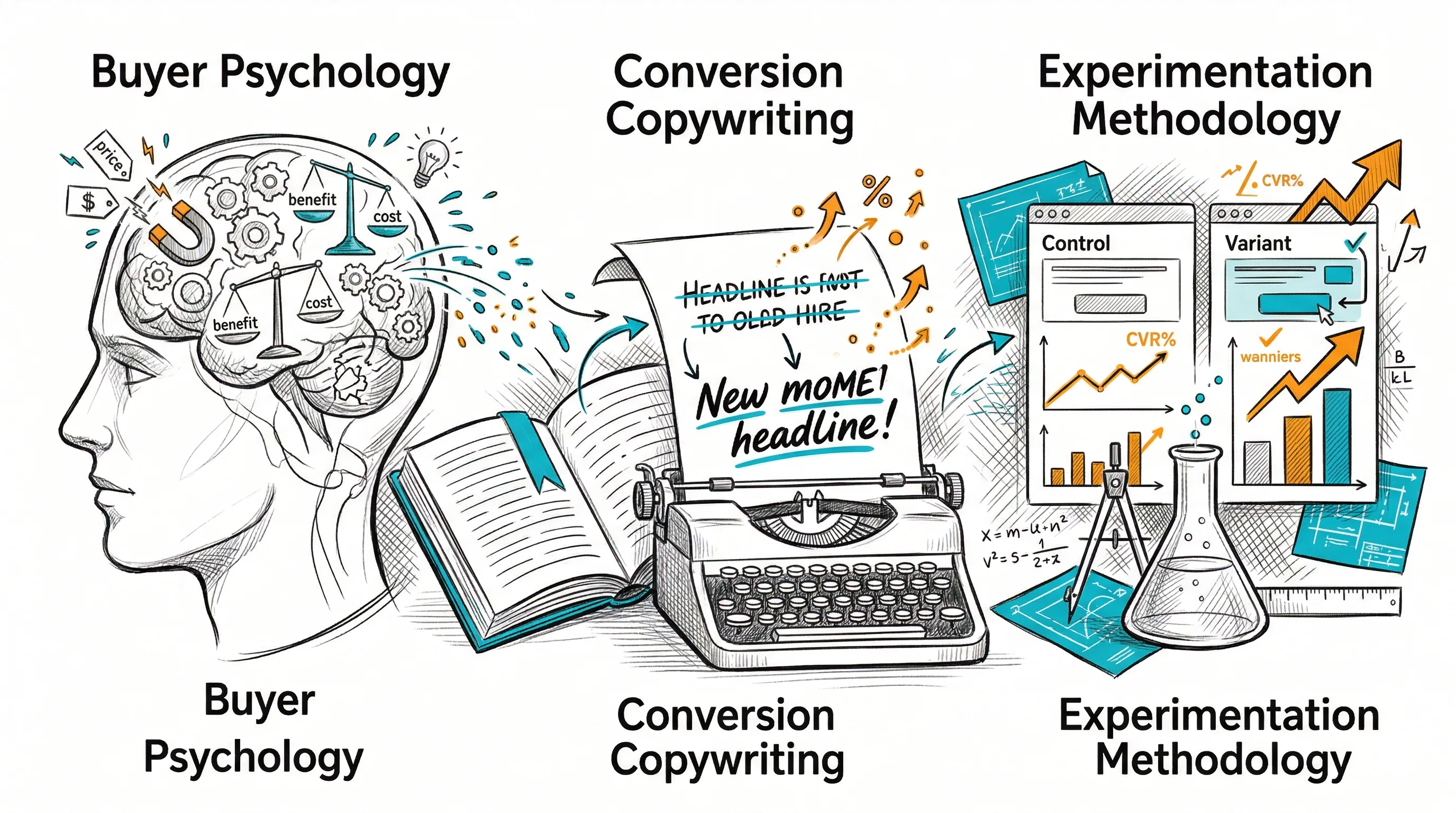
The best CRO books fall into four categories: buyer psychology (why people decide to buy or not buy), copywriting (how to communicate in ways that convert), experimentation methodology (how to design and analyze valid tests), and UX design (how to remove friction from the buyer journey). Reading across all four categories gives you the rounded foundation that separates effective CRO practitioners from those running tests without understanding why things work. Here are the 15 books that belong on every conversion optimizer's shelf.
The foundational book for anyone doing conversion work. Cialdini's six principles — reciprocity, commitment, social proof, authority, liking, and scarcity — are directly observable in every high-converting ecommerce experience.
Why it matters for CRO: Nearly every effective A/B test hypothesis connects to one of Cialdini's principles. "Add social proof near the CTA" (social proof). "Show stock scarcity" (scarcity). "Highlight expert endorsements" (authority). Reading Influence makes your hypotheses more principled.
Best passage: The chapter on social proof explains why showing "4,200 people bought this in the last 30 days" outperforms almost any other trust signal.
Cialdini's follow-up book focuses on the setup before the persuasive message — what you draw attention to before the ask determines how receptive buyers are to it.
Why it matters for CRO: The "channeling attention" concept explains why homepage heroes, above-the-fold content, and first impressions matter disproportionately to conversion.
Kahneman's framework of System 1 (fast, intuitive) and System 2 (slow, analytical) thinking explains much of buyer behavior online. Most purchase decisions are made by System 1 — which is why simplicity, visual hierarchy, and instant credibility signals matter so much.
Why it matters for CRO: If your PDP requires cognitive effort to process, System 1 defaults to "no." Reducing cognitive load is one of the highest-ROI CRO principles.
Ariely's research on irrational behavior covers anchoring, the power of free, and how context shapes perceived value. All directly applicable to pricing tests, bundle offers, and product positioning.
Why it matters for CRO: The "power of free" chapter alone has generated hundreds of CRO test ideas — adding a free gift, free shipping threshold, or free sample to an offer.
More sales methodology than academic psychology, but Tracy's frameworks on buyer decision psychology and objection handling are directly translatable to ecommerce copy and CRO hypothesis generation.
Written in 1966, this is the most sophisticated treatment of advertising copy and market awareness ever written. Schwartz's "levels of awareness" framework (unaware → problem aware → solution aware → product aware → most aware) maps directly to how you should write copy for cold traffic vs. warm traffic.
Why it matters for CRO: Your homepage copy for a visitor who came from a branded search should be very different from copy for a visitor who came from a generic category ad. Breakthrough Advertising explains why and how to adapt.
Warning: This book is expensive (collectible status) and dense. Worth it.
The most accessible book on writing content that actually serves readers and converts them. Clear, practical, and immediately actionable.
Why it matters for CRO: Most D2C ecommerce brands have product descriptions that read like spec sheets, not conversations. Handley's principles fix this.
Miller's framework positions the buyer as the hero of the story (not the brand) and the brand as the guide. This framework is particularly powerful for homepage and PDP copywriting.
Why it matters for CRO: Brands that talk about themselves ("we're India's fastest-growing D2C brand") convert worse than brands that talk about the buyer ("look and feel your best for every occasion"). StoryBrand fixes the direction of your copy.
Sugarman's book covers the mechanics of copy that sells — opening with curiosity, building desire, handling objections, and closing. Classic direct response principles that translate directly to PDP copywriting.
The most direct CRO book on the market. Goward's LIFT model (Value Proposition, Relevance, Clarity, Anxiety, Distraction, Urgency) provides a structured framework for identifying what to optimize on any page.
Why it matters for CRO: LIFT gives non-technical marketers a systematic way to audit any page and generate high-quality hypotheses. It's the closest thing to a CRO operating manual.
The definitive academic and practical treatment of A/B testing at scale. Written by the people who built experimentation platforms at Microsoft, Google, and LinkedIn. Covers everything from randomization to detecting network effects.
Why it matters for CRO: If you want to understand A/B testing statistics deeply — not just "run to 95% confidence" but understand why and when that's correct — this book is essential. It's dense but comprehensive.
Best for: Senior practitioners, CRO team leads, anyone building an experimentation program from scratch.
A more accessible treatment of statistical thinking for practitioners who don't have a statistics background. Builds intuition for when data is reliable and when it's misleading.
Why it matters for CRO: Statistical literacy prevents the most common and expensive A/B testing mistake: calling tests early based on insufficient data.
The classic usability book. Krug's central principle — that users don't read, they scan, and the best interfaces require no cognitive effort — is the foundation of ecommerce UX optimization.
Why it matters for CRO: Most CRO improvements come from reducing friction. Krug's framework explains where friction comes from and how to eliminate it.
Krug's practical guide to running user testing with minimal resources. Teaches you how to conduct 5-person usability tests that reveal more than analytics alone.
Why it matters for CRO: Qualitative user testing generates hypotheses that quantitative analytics can't. Watching 5 real buyers try to complete a purchase on your store reveals problems no heatmap will show.
Garrett's layered framework for user experience design — from strategy through structure, skeleton, and surface — gives CRO practitioners context for where individual optimizations fit in the broader experience design.
Why it matters for CRO: Helps you understand the difference between surface-level tests (button colors) and structural optimizations (page layout, information architecture) and when to prioritize each.
Start with: Influence (Cialdini) + Don't Make Me Think (Krug) + You Should Test That (Goward). These three books give you psychology, UX fundamentals, and a practical CRO framework.
Next layer: Thinking, Fast and Slow (Kahneman) + Everybody Writes (Handley) + Building a StoryBrand (Miller). Psychology depth + copywriting skills.
Advanced: Trustworthy Online Controlled Experiments (Kohavi et al.) + Breakthrough Advertising (Schwartz). Statistics depth + copywriting mastery.
Reading without action is the same as not reading. For each book:
For example, after reading Influence's chapter on social proof, your hypotheses might be:
Test all three using CustomFit.ai without any developer involvement. Let the data tell you which Cialdini principle resonates most with your specific audience.