From the conversion glossary
Concepts referenced in this article, defined.
Concepts referenced in this article, defined.
Run rigorous A/B tests and personalize every visit on Shopify or any storefront — no engineers required.
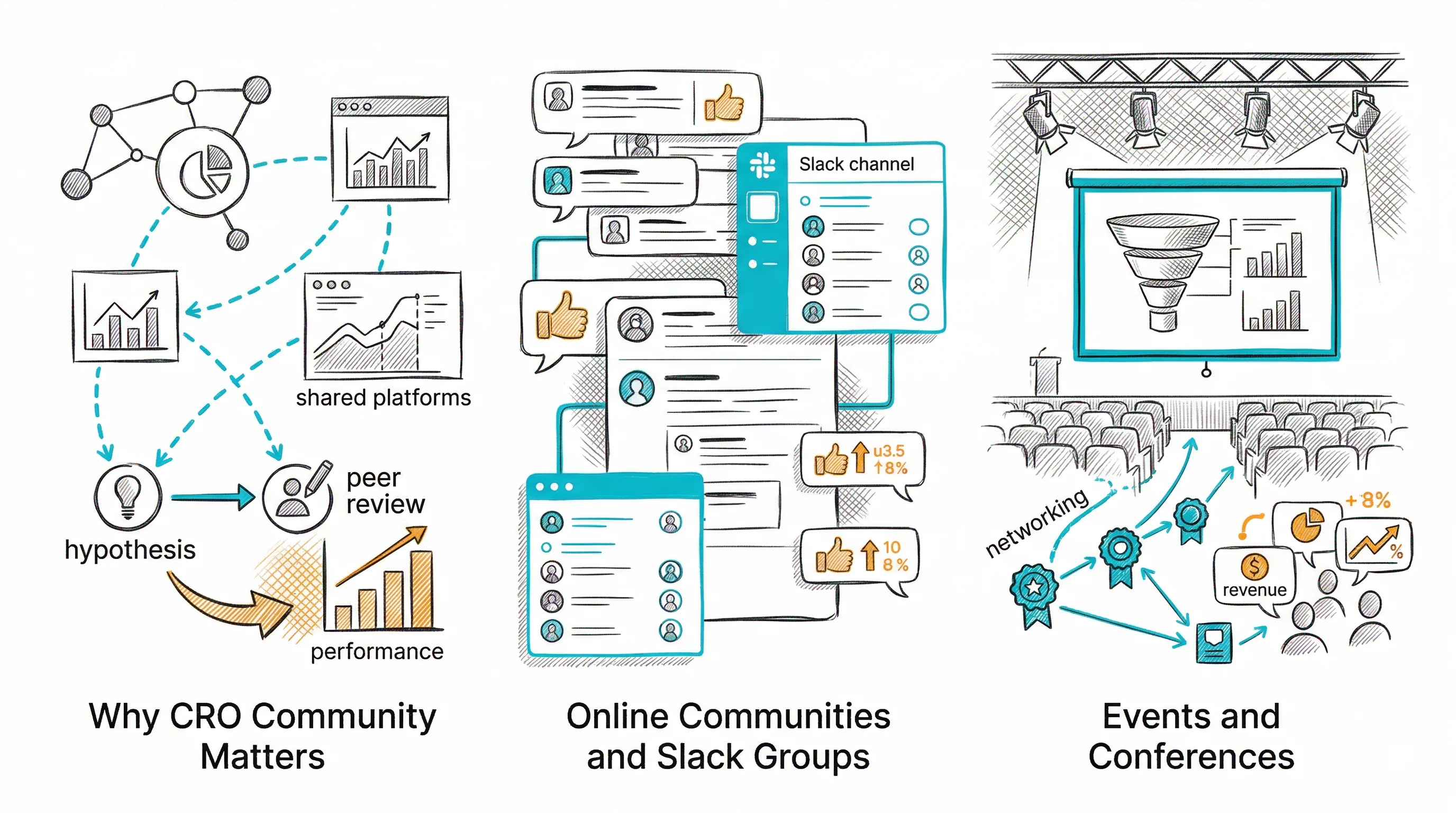
The CRO community is small, collegial, and genuinely generous with knowledge — practitioners share real test results, methodology debates, and failed experiment post-mortems in ways you rarely see in other marketing disciplines. Connecting with this community accelerates your learning, gives you access to hypothesis ideas from other industries, and provides peer review for your test methodology. Here are the best communities, events, and networks for CRO professionals in 2025.
CRO is a practice that benefits enormously from peer learning. Unlike many marketing disciplines where proprietary data is closely guarded, CRO practitioners frequently share:
The community around CRO is also unusually skeptical in a healthy way — extraordinary claims are questioned, and test results shared without methodology are challenged. This culture of rigor is valuable for developing your own critical thinking.
For Indian D2C teams, connecting with global CRO communities also exposes you to ecommerce experiments from other markets that can be adapted to Indian consumer behavior.
Best for: Professional-grade CRO discussions
The CXL community Slack is the most active dedicated CRO community available. It's primarily populated by CXL course alumni and practitioners who engage at a high level. Channels cover:
How to join: Subscribe to CXL (courses or newsletter) — community access is included.
Quality level: High. Questions get substantive answers from practitioners with real experience.
Best for: Growth practitioners with CRO overlap
Demand Curve's community focuses on growth marketing broadly — paid acquisition, SEO, content, and CRO. The CRO discussions often appear in the context of landing page optimization for ad traffic, which is highly relevant for D2C brands spending on performance marketing.
How to join: Complete Demand Curve's growth program (paid) or find community-specific access.
Quality level: High, especially for acquisition-side CRO (landing pages, ad creative testing).
Best for: Broad digital marketing community with CRO channels
Online Geniuses is a large Slack community (30,000+ members) covering all digital marketing disciplines. The CRO and UX channels are active and include practitioners from agencies, in-house teams, and freelancers.
How to join: online-geniuses.com — public community, free to join.
Quality level: Mixed. Large community means wide range of experience levels. Filter for high-quality contributors.
Best for: Indian growth and D2C practitioners
GrowthX is an Indian community focused on growth, product, and marketing for startups and D2C brands. While not CRO-specific, the community includes practitioners from major Indian D2C brands and covers conversion and retention topics with India-specific context.
How to join: growthx.club — application-based membership.
Quality level: High within the Indian D2C context. Very relevant for brands targeting Indian consumers.
Best for: Professional networking and content discovery
LinkedIn CRO groups ("Conversion Rate Optimization Professionals," "CRO Experts," etc.) have large memberships but lower signal-to-noise ratios than Slack communities. LinkedIn is more useful for:
Key practitioners to follow on LinkedIn: Peep Laja (CXL), Craig Sullivan (Optimal Visit), Tim Ash, and practitioners from major agencies and Booking.com's experimentation team.
Best for: Broad community, practical questions
Reddit communities are useful for practical questions and getting perspectives from a wide range of experience levels. For CRO specifically, r/digital_marketing and r/ecommerce have active members who discuss conversion topics. Quality varies more widely than specialized Slack communities, but real practitioners participate.
Type: Annual conference Focus: Pure CRO — methodology, case studies, and strategy Where: Austin, Texas (in-person) + virtual
CXL Live is the premier CRO conference globally. The speaker selection prioritizes practitioners with real data and results over brand-name speakers. Sessions cover advanced methodology, ecommerce-specific CRO, and program management.
Worth attending if: You're serious about CRO professionally and can access the event.
Virtual option: CXL often provides virtual access to recordings for international practitioners.
Type: Annual conference Focus: European CRO practitioners, high practitioner quality Where: Netherlands (in-person)
Known for its collaborative format and strong networking. Many of the most respected European CRO practitioners attend.
Type: Regular meetups and annual events Focus: Growth, product, and D2C in India
GrowthX organizes regular offline events in major Indian cities (Bengaluru, Mumbai, Delhi) covering growth, product, and D2C topics. CRO and experimentation topics appear regularly given the audience profile.
Best for: Indian D2C practitioners who want in-person networking with peers.
Most CRO tool companies (CustomFit.ai, VWO, CXL, Hotjar) run regular virtual webinars covering CRO topics. These are free, accessible from India, and often include Q&A with practitioners. Subscribe to CRO tool newsletters to get notified of upcoming events.
CRO communities reward data over opinions. The fastest way to build a reputation:
Share real test results. A post that says "we tested X vs Y on our Shopify store, here are the results with methodology and sample sizes" gets 10x more engagement and respect than "I think you should test X."
Document failures. Sharing a test that lost — and explaining what you learned — demonstrates statistical maturity and earns more credibility than only sharing wins.
Ask specific questions. "I'm running an A/B test on our PDP CTA with 500 visitors/day — how long should I run it for a 5% MDE at 80% power?" gets better responses than "how do I know if my test is significant?"
Cite sources. Reference the Baymard Institute study, the CXL post, or the conference talk that informed your thinking. Attribution in CRO discussions signals you've done the reading.
Be consistent. Showing up weekly and contributing regularly to a community builds recognition faster than occasional large contributions.
If you're looking to develop CRO skills with guidance:
CXL Agency Directory: Lists CRO agencies vetted by CXL. If you're hiring an agency or looking for a role in CRO, this is a credible starting point.
CRO practitioners on Twitter/X: The CRO Twitter community is smaller than LinkedIn but more technically focused. Practitioners like Craig Sullivan, Ton Wesseling, and Lukas Vermeer post regularly about methodology and experimentation culture.
Local growth communities in India: In addition to GrowthX, cities like Bengaluru have active startup and growth communities (Product Nation, iSPIRT, SaaSBoomi) where CRO topics surface in the context of SaaS and D2C growth.
A key value of global CRO communities is access to test results from other markets. When applying insights from global communities to Indian D2C:
Verify consumer behavior assumptions. A test that worked for a US ecommerce brand on checkout trust signals may behave differently with Indian buyers who have different COD preferences, UPI familiarity, and trust concerns.
Adapt, don't copy. The principle (reducing friction at checkout) translates; the specific execution (which trust badge works best) may not. Use global case studies for hypothesis inspiration, then test for your specific audience.
Share India-specific results. When you run a test relevant to Indian consumer behavior (COD messaging, UPI badges, festive urgency), sharing those results in global communities is genuinely valued — there's less India-specific CRO data available than Western ecommerce data.