From the conversion glossary
Concepts referenced in this article, defined.
Concepts referenced in this article, defined.
Run rigorous A/B tests and personalize every visit on Shopify or any storefront — no engineers required.
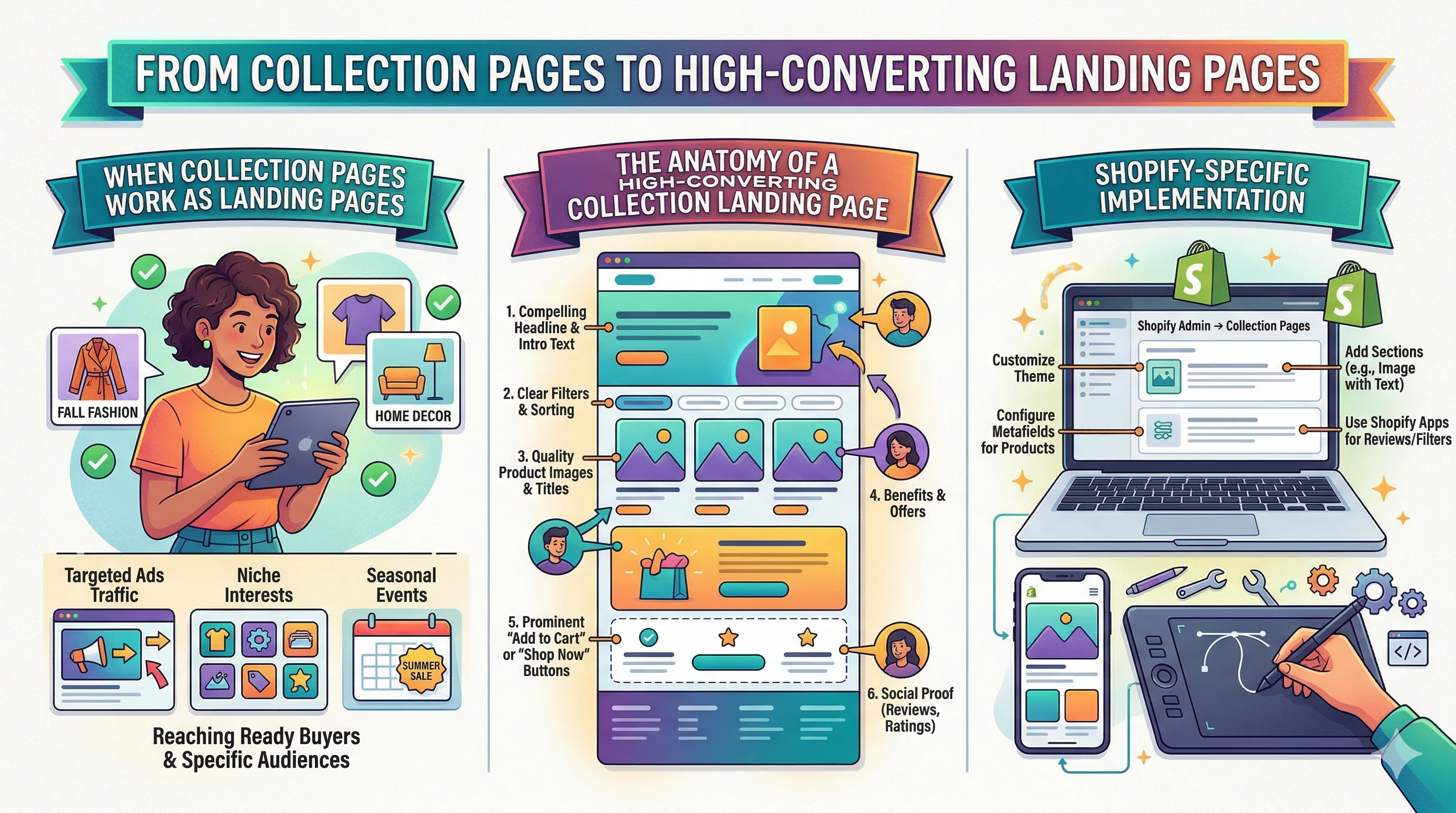
Most Shopify merchants send campaign traffic to either homepages (too broad) or individual product pages (too narrow for category campaigns). Collection pages are the overlooked middle option—and when properly optimized, they can be highly effective landing destinations for category-focused campaigns. A well-structured collection page gives visitors a curated entry point into a relevant range of products, with enough context and trust signals to convert browsers into buyers.
Not every campaign benefits from a collection page as the landing destination. The fit depends on the campaign intent:
Ideal for collection pages:
Better served by product pages:
Better served by dedicated landing pages:
A standard Shopify collection page shows products in a grid with a title. That's insufficient for landing page performance. A landing-page collection page needs:
1. Hero Section
A campaign-relevant banner or hero section at the top of the page—before the product grid. This section should:
Most Shopify themes support collection banners, but the level of design control varies. Apps like PageFly, Shogun, or GemPages offer more flexibility.
2. Trust Bar / Social Proof Strip
Below the hero and above the product grid, include a brief trust strip: "⭐ 4.8/5 — 12,000+ Reviews | Free Shipping Above ₹699 | 14-Day Easy Returns"
This answers the fundamental trust questions before the visitor even looks at products.
3. Campaign-Relevant Product Curation
Not every product in the collection is equally relevant to every campaign. For a "Monsoon Skin Care" campaign, the products sorted to the top should be the most relevant monsoon-care products—not the full catalog in default sort order.
Shopify allows manual collection sorting or sort by "Best Selling" or "Featured" as defined by you. Create a specific collection that includes only the campaign-relevant products, and use that collection as the landing destination.
4. Product Grid Optimization
Product cards in the grid should show, at minimum: product name, price, star rating, and key benefit or callout (e.g., "Bestseller," "New," "Limited Time"). Collection pages where products are generic (name + price only) convert significantly lower than those where product cards communicate value.
5. Category-Level Social Proof
Below the product grid (or in a section within the hero), include:
6. FAQ or Content Block
For higher-consideration categories, a brief FAQ or educational content block between the product grid and the page footer serves two purposes: helps customers make informed decisions, and adds keyword-relevant content for SEO.
Creating campaign-specific collections:
Don't use your main "Skincare" collection (which shows all skincare products) as the landing destination for a targeted "Summer Brightening" campaign. Create a new collection specifically for the campaign:
This collection is your landing page. Link your ad to this collection URL.
Removing navigation for high-intent traffic:
For performance campaigns where conversion focus is paramount, consider temporarily modifying or removing the main navigation from the collection page template—or using a separate landing page template (Shopify supports multiple templates per page type).
Warning: This requires theme code modification. If you're not comfortable with code, use CustomFit.ai to conditionally hide navigation elements for visitors arriving from specific UTM parameters.
Using CustomFit.ai for collection page personalization:
CustomFit.ai can:
This means one collection page URL can serve multiple campaign audiences with appropriately matched content.
Collection pages are particularly valuable for personalization because a returning visitor who previously browsed "hair care" should see a different collection experience than a first-time visitor arriving from a hair-specific ad.
Personalization scenarios:
New vs. returning visitors: New visitors see the full collection with trust signals and social proof prominently. Returning visitors (who already know the brand) see a "Welcome back, here's what's new" experience with new arrivals first.
Campaign source: A visitor from an influencer's hair oil recommendation sees the hair oil featured first in the collection, with the influencer's testimonial highlighted. A visitor from a Google search for "best ayurvedic hair care" sees an SEO-optimized header and product sort.
Purchase history: A customer who has bought hair oil before sees complementary products (hair mask, scalp serum) highlighted rather than the same hair oil they already own.
CustomFit.ai's Shopify integration enables all of these without developer work—set up rules based on UTM parameters, visit count, and purchase history.
The metrics for collection pages as landing pages include:
CVR (from page to purchase): Primary metric. What percentage of visitors to this collection page ultimately purchase?
Category page bounce rate: Are visitors leaving immediately? If high, hero section message match is likely the issue.
Product click-through rate from collection: What percentage of visitors click into product pages? Low click-through suggests product cards aren't compelling, or the collection curation isn't matching visitor intent.
Time on page: Longer time indicates engagement; shorter time (combined with low CVR) indicates mismatch or poor collection UX.
AOV from collection page sessions: Do visitors who enter through this collection page have higher or lower AOV than your store average?
Indian D2C brands benefit enormously from well-executed seasonal collection pages:
Diwali Collection: A curated page featuring gifting sets, festive-appropriate products, premium packaging options. This page should be live and optimized 3–4 weeks before Diwali, with campaign-specific imagery (festive lighting, warm tones).
Summer / Monsoon Skincare: A curated selection matching seasonal skin concerns. For monsoon: humidity-control, anti-fungal care, lightweight moisturizers.
Wedding Season Collection: Bridal prep, bridesmaid gifting, ethnic wear accompaniments. Creates natural high-AOV purchases for occasion-driven buyers.
Each of these seasonal collections serves as a landing destination for seasonal campaigns—paid, email, and organic. Build them in advance; optimize based on early performance data.
Links: Landing Page Optimization | Conversion Rate Optimization | Personalization | Landing Page Optimization Pillar | Landing Page vs Homepage | Ad Landing Page Message Match