CustomFit.ai — Website personalization, A/B testing and CRO for Shopify and D2C
Product
Features
✱
Website Personalization
Adapt to each visitor's behavior & intent
⧖
A/B & Multivariate Testing
Rigorous experimentation
✨
AI CopilotNEW
Personalize with a prompt
🤖
AI WingmanNEW
Auto-optimize toward winners
🎯
AI Conversion OptimizerNEW
GPT-grade test ideas
✎
No-Code Visual Editor
Drag-and-drop edit any element
▦
Product Recommendations
Personalized recs that lift AOV
⚑
Feature Flags
Ship safely with kill-switches
◧
Chrome Extension
Edit your store in the browser
⧉
Shopify, WooCommerce & more
All platform integrations
View all features →
Use Cases
$
Price A/B Testing
Test price points to maximize revenue
▦
Theme A/B Testing
Compare whole layouts & designs
🗂
Template A/B Testing
Test whole PDP/PLP templates
🏷
Discount A/B Testing
Find the offer that converts
🚚
Shipping A/B Testing
Thresholds, speed & copy
✍
Content A/B Testing
Copy, images & reviews
💳
Checkout Gateway A/B
Payments & one-click
⌖
Geo-Based Personalization
Per-location content & offers
⚡
Buyer-Intent Nudges
Exit-intent & retargeting
↔
Split-URL / Redirection
Full-page redirect tests
View all use cases →
Solutions & Guides
⤢
Conversion Rate Optimization
The complete CRO guide
⧖
A/B Testing Software
Buyer's guide for D2C
🛒
Cart Abandonment Recovery
Win back lost carts
📰
Landing Page Optimization
Convert more paid traffic
S
Shopify A/B Testing
Test your store, no code
S
Shopify Personalization
Tailor the store per shopper
◔
First-Time Visitor Offers
Convert new shoppers with trust & offers
★
Repeat-Customer Experiences
Reward and re-engage loyal buyers
◎
Campaign-Matched Pages
Match the landing page to the ad
⌖
Location-Based Experiences
Currency, language & regional offers
Explore CRO →
Customer stories
GIVA
+32%
conversion via personalized recs
GIVA
Mamaearth
+18%
revenue lift from PDP A/B tests
ME
The Sleep Company
+24%
AOV from product recommendations
TSC
Read customer stories →
Integrations
SWsfGA+15
✦
Not sure where to start?
Let AI Copilot pick your first tests

“We wake up to evidence-backed tests ready to deploy — not a backlog of maybe ideas.”

AN
Anirudh S.
Growth · Chargebee
★★★★★4.8on G2 · 2,400+ brands
Talk to our team →
Widgets
Integrations
Ecommerce & Checkout
Shopify
Shopline
Shoplazza
GoKwik
ShopFlo
Razorpay Magic Checkout
Breeze
Shiprocket
View all integrations →
Analytics & Behavior
Google Analytics 4
Microsoft Clarity
Hotjar
Mixpanel
Amplitude
Heap
Adobe Analytics
Segment (CDP)
View all integrations →
Engagement, CRM & More
Klaviyo
MoEngage
CleverTap
WebEngage
HubSpot
Salesforce
Slack
Meta Ads
View all integrations →
CustomersPricing
Resources
CRO
▤
Playbooks
Proven strategies to boost conversions
🎙
Interviews
D2C leaders & marketing experts
▶
Webinars
Live deep dives & product sessions
Learn
✎
Blog
Tips, experiments & best practices
📕
Free E-Books
Mastering personalization
📖
Conversion Glossary
Every CRO term, defined
✦AI CopilotNEWLog inBook a demo
Start free trial
Select your platform — Install in 2 minsWe'll tailor the setup
⚡ Risk-free 14-day trial · No credit card · Cancel anytime
S
Shopify
Install from Shopify App Store
›
W
WooCommerce
Install the WooCommerce plugin
›
B
BigCommerce
Install from BigCommerce App Marketplace
›
SL
Shopline
Install from Shopline App Store
›
M
Salesforce / Magento
Install from the marketplace
›
SZ
Shoplazza
Install from Shoplazza App Store
›
WP
WordPress / Webflow
Install plugin or paste the script
›
◧
Others
Custom-built on React, Next.js, etc.
›
Tip: pick your platform — we handle the restBook a demo →
Product
Website PersonalizationA/B & Multivariate TestingAI CopilotAI WingmanAI Conversion OptimizerNo-Code Visual EditorProduct RecommendationsFeature FlagsView all features →
Use Cases
Price A/B TestingTheme A/B TestingTemplate A/B TestingDiscount A/B TestingShipping A/B TestingContent A/B TestingCheckout Gateway A/BGeo-Based PersonalizationBuyer-Intent NudgesSplit-URL / Redirection
Solutions & Guides
Conversion Rate OptimizationA/B Testing SoftwareCart Abandonment RecoveryLanding Page OptimizationShopify A/B TestingShopify Personalization
Explore
WidgetsIntegrationsCustomersPricing
Resources
BlogPlaybooksWebinarsInterviewsE-BooksConversion Glossary
Platforms
ShopifyShoplineShoplazzaChrome ExtensionAll integrations
Start free trialBook a demo
Home›Blog›product page›Product Page SEO: Rank and Convert

Product Page SEO: Rank and Convert

SJSapna JoharHead of Growth & CRO, CustomFit.aiJanuary 15, 20259 min read
On this page
  1. Why Most Product Pages Fail at SEO
  2. Title Tags and H1: The Foundation
  3. Product Descriptions That Rank and Sell
  4. Schema Markup: Winning SERP Features
  5. Reviews: The Double Conversion Driver
  6. Page Speed and Core Web Vitals
  7. Meta Descriptions: Improve Click-Through Rate
  8. Internal Linking from Product Pages
  9. Tips / Best Practices
  10. Key Takeaways
0%
Product Page SEO: Rank and Convert

From the conversion glossary

Concepts referenced in this article, defined.

Definition
What Is Core Web Vitals? Definition & Guide
Definition
What Is Page Speed? Definition & Guide
Definition
What Is Social Proof? Definition & Guide
Definition
What Is Breadcrumb Navigation? Definition & Guide
Definition
What Is Category Page? Definition & Guide
← Back to Product Page guide
Try CustomFit.ai

Run A/B tests and personalize your store without code. 14-day free trial, no credit card.

Start free trial →
Share
XLinkedInEmail

Related articles

product page

Size Guide Optimization for Fashion Ecommerce

Sapna Johar· 8 min read
product page

Product Video: How It Impacts Conversion Rates

Ashwin Kumar· 9 min read
product page

Product Reviews Strategy for Ecommerce

Ashwin Kumar· 8 min read

Start lifting conversions today.

Run rigorous A/B tests and personalize every visit on Shopify or any storefront — no engineers required.

Start free trialBook a demo

Built for every D2C category

🧴
Skincare
💄
Beauty
🌿
Wellness
☕
F&B
👟
Apparel
💍
Jewelry
🛋️
Home
🍼
Baby
Live · Right now
Mamaearth — free-shipping band +12.4% AOVGIVA — festive collection page +34% revenueBellavita — PDP CTA test +27.4% CVRKapiva — Quiz-driven recs +9.48% CTRThe Sleep Co — landing personalized 2× capturesPlum — Returning shopper swap +18.2% CVRMamaearth — free-shipping band +12.4% AOVGIVA — festive collection page +34% revenueBellavita — PDP CTA test +27.4% CVRKapiva — Quiz-driven recs +9.48% CTRThe Sleep Co — landing personalized 2× capturesPlum — Returning shopper swap +18.2% CVR
Get in touch

Tell us about your store.

We reply within an hour during business hours. No sales pitch, no spam — just answers from someone who's seen 2,400+ D2C stores.

✓ Reply within 1 hour✓ No spam, ever✓ Free demo & setup help
✓ Thanks! We'll be in touch shortly.
CustomFit.ai

The all-in-one website personalization, A/B testing & CRO platform for high-growth D2C brands. Made by marketers, fueled by coffee.

in𝕏◎▶f
Product
  • Features
  • A/B Testing
  • Personalization
  • AI Copilot
  • AI Wingman
  • AI Conversion Optimizer
  • Feature Flags
  • Widgets
  • Integrations
  • ROI Calculator
Platforms
  • Shopify
  • Shopline
  • Shoplazza
  • Salesforce
  • Chrome Extension
  • All Integrations
Resources
  • Blog
  • Playbooks
  • Webinars
  • GrowthFit Interviews
  • Free E-Books
  • Conversion Glossary
  • Case Studies
Compare
  • vs VWO
  • vs Optimizely
  • vs Google Optimize
  • vs Mutiny
  • vs Intelligems
  • vs Shoplift
  • vs AB Tasty
  • vs Convert
  • vs Kameleoon
Company
  • About Us
  • Partners
  • CustomFit Awards
  • Recognition
  • Contact
  • Privacy Policy
  • Terms & Conditions
© 2026 CustomFit.ai · Valley Monks Pvt Ltd · Made by marketers, fueled by coffee, and obsessed with conversions.
SOC 2 Type II · GDPR · CCPA · ISO 27001

A product page that ranks on page 2 of Google earns almost no traffic. A product page that ranks on page 1 but doesn't convert earns traffic but not revenue. The goal is both—and the tactics for ranking and converting are more aligned than most brands realize. This guide covers what it takes to optimize D2C product pages for search visibility and sales simultaneously.

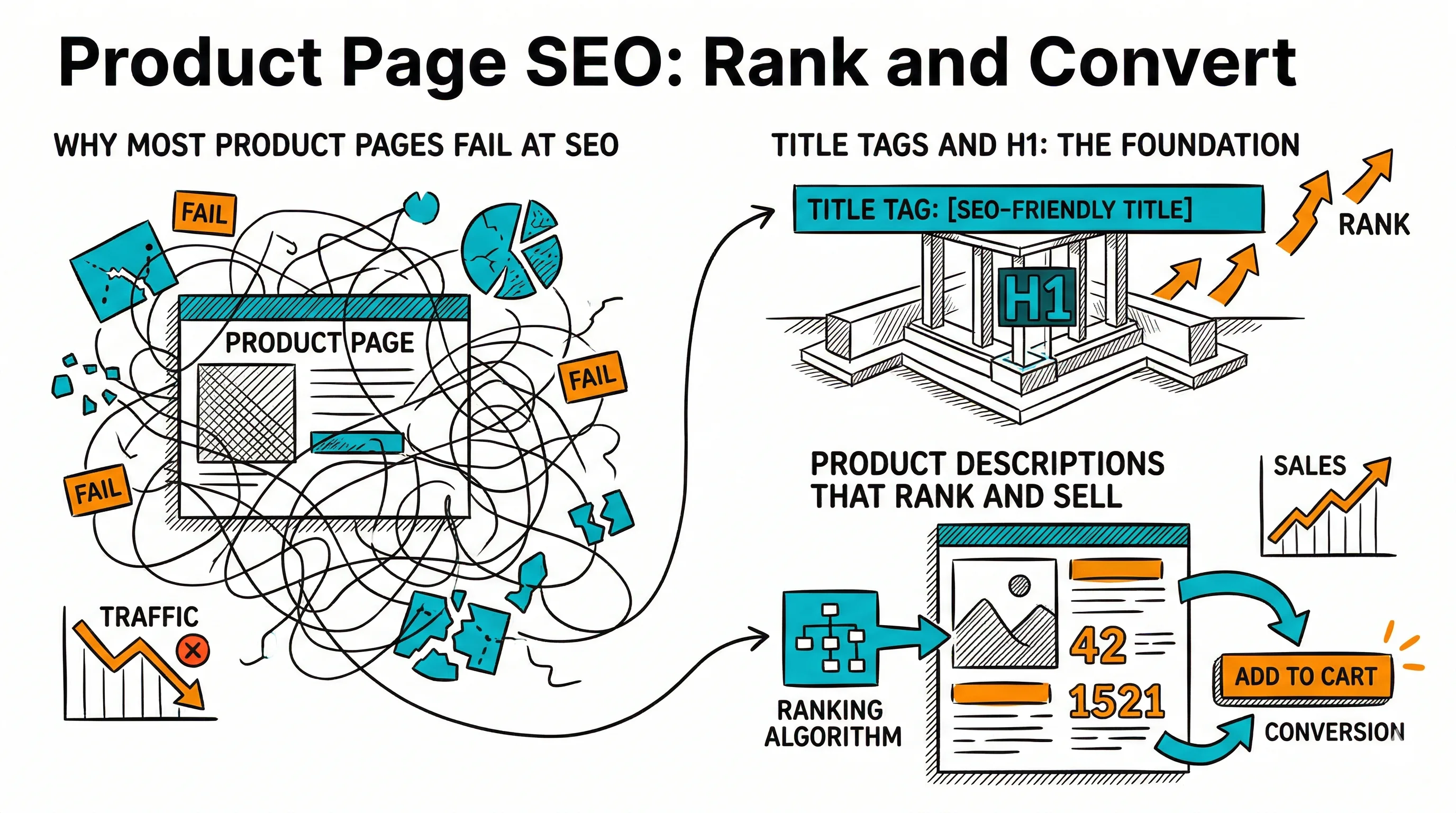
Why Most Product Pages Fail at SEO

The typical D2C product page has:

  • A title tag that's just the product name (no keyword context)
  • A 2–3 sentence product description copied from the manufacturer
  • No schema markup
  • Generic or duplicate meta description
  • Reviews with no structured markup

This combination means the page ranks poorly (no keyword signals, no structured data), gets low click-through rates (no star ratings in SERP), and converts poorly even when it does rank (thin content doesn't answer purchase questions).

The fix requires treating the product page as both a sales page and a content asset.

Title Tags and H1: The Foundation

The title tag is the most important on-page SEO element. It tells Google what the page is about and appears as the clickable headline in search results.

Formula for product page title tags: [Product Name] | [Primary Keyword] | [Brand Name]

Example: "Vitamin C Face Serum 20% | Best Brightening Serum | Plum Goodness"

This structure includes: the product (what it is), the keyword customers search (brightening serum), and the brand (trust and recognition).

What to avoid:

  • Title tags identical to product name only: "Vitamin C Serum 30ml" tells Google and customers nothing useful
  • Keyword stuffing: "Best Vitamin C Serum Buy Vitamin C Serum India Brightening" looks spammy and gets clicked less

The H1 on the page should match the intent of the title tag but can be written slightly more naturally. Google expects the title tag and H1 to align. If the title tag is "Vitamin C Face Serum 20% | Brightening Serum | Plum", the H1 might be "Plum 20% Vitamin C Face Serum for Radiant Skin."

Product Descriptions That Rank and Sell

Product descriptions do two jobs: convince a visitor to buy, and signal to Google what the page is about.

The twin failure mode: Descriptions that are purely sales copy (benefit-focused, no natural keyword inclusion) rank poorly. Descriptions that are purely keyword-stuffed (unnatural language, repetitive) don't convert.

The structure that does both:

  1. Opening paragraph: Lead with the product's primary benefit, naturally including the primary keyword. "Plum's 20% Vitamin C serum is formulated for daily brightening, combining stable L-ascorbic acid with niacinamide to visibly reduce dark spots within 4–6 weeks."

  2. Ingredient/specification section: Where semantically related keywords appear naturally—ingredient names, technical specifications, usage instructions. "Contains: L-Ascorbic Acid 20%, Niacinamide 5%, Hyaluronic Acid 2%. Suitable for: oily, combination, and normal skin. Not recommended for: active acne or very sensitive skin."

  3. Benefits/features section: Bulleted list of key benefits, written in customer language. These often match the longtail terms customers search.

  4. Usage instructions: How to use, when to use, what to use with. Tutorial-style content that also captures "how to use vitamin C serum" searches.

  5. FAQ section (discussed further below): Structured Q&A that captures conversational search queries.

Length: For most products, 200–400 words covers this structure. For high-consideration products (supplements, electronics, skincare for specific conditions), 500–800 words can help capture additional keyword surfaces.

Schema Markup: Winning SERP Features

Product schema markup tells Google to display rich information about your product directly in search results—price, availability, reviews, and more. Without it, you're leaving SERP real estate on the table.

Essential schema types for D2C product pages:

Product schema: Name, description, brand, SKU, image, offers (price, availability, currency). This enables the product information panel in search results.

Review/AggregateRating schema: Total review count and average rating. This generates the star rating display in SERPs—which improves click-through rate by 15–30% in most studies.

BreadcrumbList schema: Navigation path. Helps Google understand site structure and displays category breadcrumbs in search results.

FAQ schema: Frequently asked questions about the product. Generates FAQ expandables directly in search results, significantly increasing SERP real estate.

On Shopify, structured data is often partially handled by themes—but product schema completeness varies significantly by theme. Audit your existing schema using Google's Rich Results Test tool and add or fix gaps.

Reviews: The Double Conversion Driver

Customer reviews help product pages in two distinct ways:

SEO value: Reviews add continuously-refreshed, keyword-rich content to product pages. Real customers naturally use the words other customers search: "this serum helped with my dark spots," "good for Indian skin tones in humid weather," "works well under sunscreen." This language boosts semantic relevance.

Conversion value: Reviews reduce purchase hesitation by providing social proof from real buyers. Star ratings, review volume, and specific testimonials all influence purchase confidence.

Review strategy for SEO:

  • Actively solicit reviews post-purchase (email at day 10–14 asking for feedback)
  • Use review prompts that encourage specificity: "Tell us about your skin type and what you were hoping to achieve" generates more useful reviews than "Leave a review"
  • Implement review schema markup to enable star ratings in SERPs
  • Display total review count prominently—100+ reviews signals trust; 8 reviews signals uncertainty

Page Speed and Core Web Vitals

Google's Core Web Vitals are ranking factors—and page speed directly affects conversions. A product page that loads in 2 seconds converts significantly better than one that loads in 5 seconds.

The three CWV metrics:

LCP (Largest Contentful Paint): Time until the largest image or text block loads. For product pages, this is almost always the hero product image. Target: under 2.5 seconds. Fix: WebP images, CDN, properly sized images (don't serve a 4000px image for a 600px display container).

FID (First Input Delay): Time until the page responds to the first user interaction. Target: under 100ms. Fix: reduce JavaScript load, defer non-critical scripts.

CLS (Cumulative Layout Shift): How much page elements jump around as the page loads. Target: under 0.1. Fix: define image dimensions in HTML so the browser reserves space before the image loads.

For Shopify stores, the biggest LCP issues are typically: unoptimized product images, unminified JavaScript from apps, and excessive font loading.

Quick wins for Shopify product page speed:

  • Convert product images to WebP format (significant file size reduction)
  • Lazy load images below the fold
  • Remove unused Shopify apps (each adds JavaScript overhead)
  • Use Shopify's built-in CDN for images

Meta Descriptions: Improve Click-Through Rate

Meta descriptions don't directly affect rankings—but they affect click-through rate (CTR), which does affect rankings indirectly (higher CTR signals relevance to Google).

An effective product page meta description:

  • States clearly what the product is and does (includes primary keyword)
  • Includes a specific benefit or differentiator ("20% Vitamin C, formulated for Indian skin")
  • Has a subtle call to action ("Shop with 14-day returns")
  • Stays under 155 characters (to avoid truncation in SERPs)

Example: "Shop Plum's 20% Vitamin C Face Serum—formulated for dark spots and brightening on Indian skin tones. Free shipping above ₹499. 14-day easy returns."

This includes the keyword (Vitamin C Face Serum), a brand-specific claim (formulated for Indian skin tones), and a purchase-reduction trust signal (free shipping, returns).

Internal Linking from Product Pages

Internal links from product pages distribute link equity through your site and help Google discover related pages.

Effective internal linking:

  • Link to the category page (breadcrumb navigation)
  • Link to related products ("Pairs well with our Niacinamide Moisturizer")
  • Link to relevant blog/content pages ("Learn how to build a Vitamin C skincare routine")
  • Link to comparison pages if they exist

Cross-linking between product pages within the same collection keeps visitors on site longer and increases average pages per session—both positive signals for Google.

Tips / Best Practices

  1. Write unique title tags and meta descriptions for every product page. Duplicate meta data confuses Google and reduces SERP differentiation.
  2. Implement full product schema markup including reviews, price, and availability. Audit with Google's Rich Results Test.
  3. Include FAQ content on high-consideration product pages. Structured FAQs with schema markup can win SERP real estate directly below your result.
  4. Solicit reviews actively and display them prominently. 50+ reviews is the threshold where social proof starts meaningfully moving CVR.
  5. Convert all product images to WebP format and ensure images are sized for their display container (not served at 4000px when displayed at 600px).
  6. Write product descriptions in customer language, not brand language. Use terms your customers actually search, not just industry terminology.
  7. Add breadcrumb navigation to product pages—it helps Google and helps mobile users understand site structure.
  8. Audit Core Web Vitals monthly using Google Search Console. LCP issues typically appear first and are highest priority.
  9. Use longtail keywords in your description naturally. "Best vitamin C serum for dark spots on oily skin" is a real search query—if your description covers it naturally, you can rank for it.
  10. A/B test title tag variations to find which formulations drive higher click-through rates. CustomFit.ai enables this without developer involvement.

Key Takeaways

  • Product page SEO requires optimizing for both ranking (Google signals: keywords, schema, speed) and converting (buyers: copy, reviews, trust signals). These goals are more aligned than they appear.
  • Title tags and H1s should include primary keywords naturally and prominently—not just product names.
  • Product schema markup is non-negotiable: it enables star ratings, price display, and availability information in SERPs, which dramatically improve CTR.
  • Customer reviews serve double duty—adding keyword-rich content for SEO and building purchase confidence for conversion. Actively soliciting them pays off on both dimensions.
  • Core Web Vitals (especially LCP) are ranking factors and conversion factors. Slow product pages lose on both counts.
  • Internal linking from product pages helps both SEO (link equity distribution) and conversion (keep visitors engaged with related content and products).

Links: Search Engine Optimization | Conversion Rate | Social Proof | Product Page Optimization Pillar | Product Page Layout Best Practices | Product Photography Conversions