From the conversion glossary
Concepts referenced in this article, defined.
Concepts referenced in this article, defined.
Run rigorous A/B tests and personalize every visit on Shopify or any storefront — no engineers required.
Ethnic wear is India's largest apparel category — and also one of the most conversion-challenging categories in online retail. Buyers face compounding uncertainties: Will the colour match what I see on screen? Will the fabric feel as described? Will it fit my body type? Will it arrive before the occasion? Each of these uncertainties is an A/B testing opportunity. From festive kurti brands to wedding lehenga stores, these 10 ideas address the specific conversion barriers of the Indian ethnic wear market.
Online ethnic wear CVR averages 1.5–3%, held back by colour accuracy concerns, sizing complexity (ethnic sizing conventions vary by region and style), and the occasion-specific nature of purchases (if the outfit arrives late, it's worthless). Brands like FabIndia, Manyavar, and BIBA have built category-leading conversion through a combination of trust signals, occasion marketing, and detailed product information. Your split testing roadmap should focus on these same three pillars.
Description: Add "Shop by Occasion" as the primary navigation on category pages — with categories like: Wedding Guest | Puja & Festival | Office Ethnic | Casual Ethnic | Bridesmaids | Mehndi Night | Navratri — before colour and size filters.
Why it works: Ethnic wear buyers shop by occasion, not by colour or silhouette. A woman looking for a "navratri chaniya choli" doesn't want to browse 500 products — she wants to see the 30 that are right for Navratri. Occasion navigation is the single biggest friction reduction in ethnic wear discovery.
Best for: All ethnic wear category pages.
Expected lift: 12–20% product page click-through from category pages.
Description: Create dedicated landing pages for each major Indian festival — Navratri, Diwali, Eid, Pongal, Durga Puja, Onam — with curated collections, a countdown to the festival, and a prominent "Guaranteed delivery before [festival date]" message.
Why it works: Timing anxiety is the #1 objection for festive ethnic wear purchases. A page that explicitly guarantees delivery before the festival removes this objection and converts the purchase from "risky" to "safe." Brands that execute this well see 30–45% CVR lift on festive pages vs. generic category pages.
Best for: All festive season traffic.
Expected lift: 30–45% CVR improvement on festive-specific landing pages.
Description: Add a dedicated "Fabric & Care" card on all product pages showing: fabric composition (e.g., 70% pure silk, 30% georgette), weave type (Banarasi, Kanjeevaram, Chanderi), care instructions, and a hand-feel descriptor (e.g., "light and flowy, cool against skin").
Why it works: Fabric uncertainty is the #2 objection for ethnic wear (after sizing). Online buyers cannot touch the fabric — but detailed, specific fabric information (not just "polyester blend") creates confidence. Brands that show weave provenance and hand-feel descriptions see significantly higher trust scores.
Best for: All silk, cotton, and handloom products.
Expected lift: 8–15% add-to-cart rate improvement.
Description: Show each product on models of at least 3 different skin tones (fair, medium, and deep) — because colour perception differs dramatically across skin tones, especially for dupatta and blouse combinations.
Why it works: Indian buyers know that "rose gold" looks different on fair and dark skin. A customer with a deep complexion wants to see how a pastel suit will look on someone who looks like her. This is representation as a conversion tool — not just an equity consideration.
Best for: All sarees, suits, lehengas, and kurtas where colour perception varies.
Expected lift: 10–18% add-to-cart rate improvement.
Description: Replace the static size chart with an interactive size guide that includes: a 60-second video showing how to measure bust, waist, and hips at home, a measurement input tool that recommends a size, and model measurements + fit notes for each size displayed.
Why it works: Ethnic sizing is confusing — XL in one brand is M in another, and saree "standard" vs. "plus" sizing follows no consistent standard. A video measurement guide reduces uncertainty and return rates simultaneously, while also converting buyers who abandon at the size question.
Best for: All fitted ethnic garments: suits, lehengas, blouses.
Expected lift: 7–13% CVR improvement; 20–25% reduction in size-related returns.
Description: For handloom and handcrafted ethnic products, add a "Made by Hand" section: the weaver's name and region, the craft tradition (Lucknowi chikankari, Pochampally ikat, Kutchi bandhani), the number of hours of handwork per piece, and a photo of the craftsperson at work.
Why it works: Indian buyers who specifically seek handloom products are willing to pay a premium for authenticity. Documenting craft provenance transforms a product from a garment into a piece of cultural heritage — and justifies pricing that would otherwise seem high vs. machine-made alternatives.
Best for: All handloom, handblock-print, and hand-embroidered products.
Expected lift: 12–20% CVR improvement for handloom-segment buyers; significant uplift in willingness to pay.
Description: Add a "Complete the Look" section below the product images showing the full outfit — dupatta, jewellery, footwear, potli bag, bindi — with clickable links to matching products on your store or partner brands.
Why it works: Ethnic wear buyers often struggle to style a complete look online. A "complete the look" section that shows the cohesive outfit reduces styling anxiety, increases purchase confidence, and significantly increases AOV through associated purchases.
Best for: Sarees, lehengas, salwar suits, anarkali — any garment worn with accessories.
Expected lift: 15–25% AOV increase from buyers who engage with the complete look section.
Description: Add a "Colour Accuracy Guarantee" badge and a "Request a Fabric Swatch — ₹49, applied to your order" option on product pages for all products where colour is critical to purchase (sarees, lehengas, suit sets).
Why it works: Colour inaccuracy is the #1 cause of ethnic wear returns. A brand that is confident enough to offer a swatch and guarantee colour accuracy signals product confidence. The ₹49 swatch option also generates pre-purchase engagement from high-intent buyers who haven't yet committed.
Best for: All premium ethnic wear where colour fidelity is critical.
Expected lift: 6–12% CVR improvement; 15–20% reduction in colour-related returns.
Description: Detect visitor location (state/city) and personalise homepage and category page content for regional festivals: show Onam collection to Kerala visitors in August, Pongal range to Tamil Nadu visitors in January, Durga Puja specials to Bengal visitors in October.
Why it works: India's regional diversity means "festive collection" means different things to different audiences. A Tamil Nadu visitor during Pongal wants silk sarees in yellow and green — not Diwali salwar suits. Geo-personalisation makes the homepage immediately relevant and reduces browse time.
Best for: Stores with diverse regional collections covering multiple Indian traditions.
Expected lift: 10–18% engagement improvement; 8–14% CVR lift for matched regional visitors.
Description: Display COD as the first payment option and add a trust line on product pages: "Don't love it? Return it — free pickup within 7 days."
Why it works: The combination of COD availability and easy returns removes the dual financial risks of ethnic wear: paying in advance for something that might not look right and the hassle of returning it. This is especially impactful for first-time buyers in Tier 2 and Tier 3 cities.
Best for: First-time buyer traffic, Tier 2/3 city segments.
Expected lift: 8–14% checkout completion rate for COD-preferring segments.
| Test Idea | Difficulty | Expected CVR Lift | Best Page |
|---|---|---|---|
| Occasion-based navigation | Medium | 12–20% CTR | Category page |
| Festive landing pages | High | 30–45% | Landing page |
| Fabric detail card | Low | 8–15% | Product page |
| Multi-skin-tone photography | High | 10–18% | Product page |
| Size guide with video | Medium | 7–13% | Product page |
| Craft heritage story | Medium | 12–20% | Product page |
| Complete the look section | Medium | 15–25% AOV | Product page |
| Colour accuracy guarantee | Low | 6–12% | Product page |
| Regional festival personalisation | High | 8–14% | Homepage |
| COD prominence | Low | 8–14% | Product/Checkout |
Treat festival seasons as conversion experiments in themselves. Each major festival is a distinct traffic segment with specific intent. Run dedicated experiments per festival rather than a single "festive season" test.
Track return rates alongside conversion rate. A test that lifts CVR but also lifts returns by 30% is a net loss. Always measure both. Ethnic wear has naturally high return rates — any test that reduces them while maintaining CVR is worth double-weighting.
Use statistical significance thresholds rigorously. Ethnic wear stores often see large seasonal traffic swings. Run tests in stable non-festive periods, then apply winners during festival peaks.
Build a regional festival calendar. India has 30+ major regional festivals. Map your top 10 by traffic potential and build dedicated test plans for each. Start with Navratri, Diwali, and Eid — the three highest-revenue windows for ethnic wear.
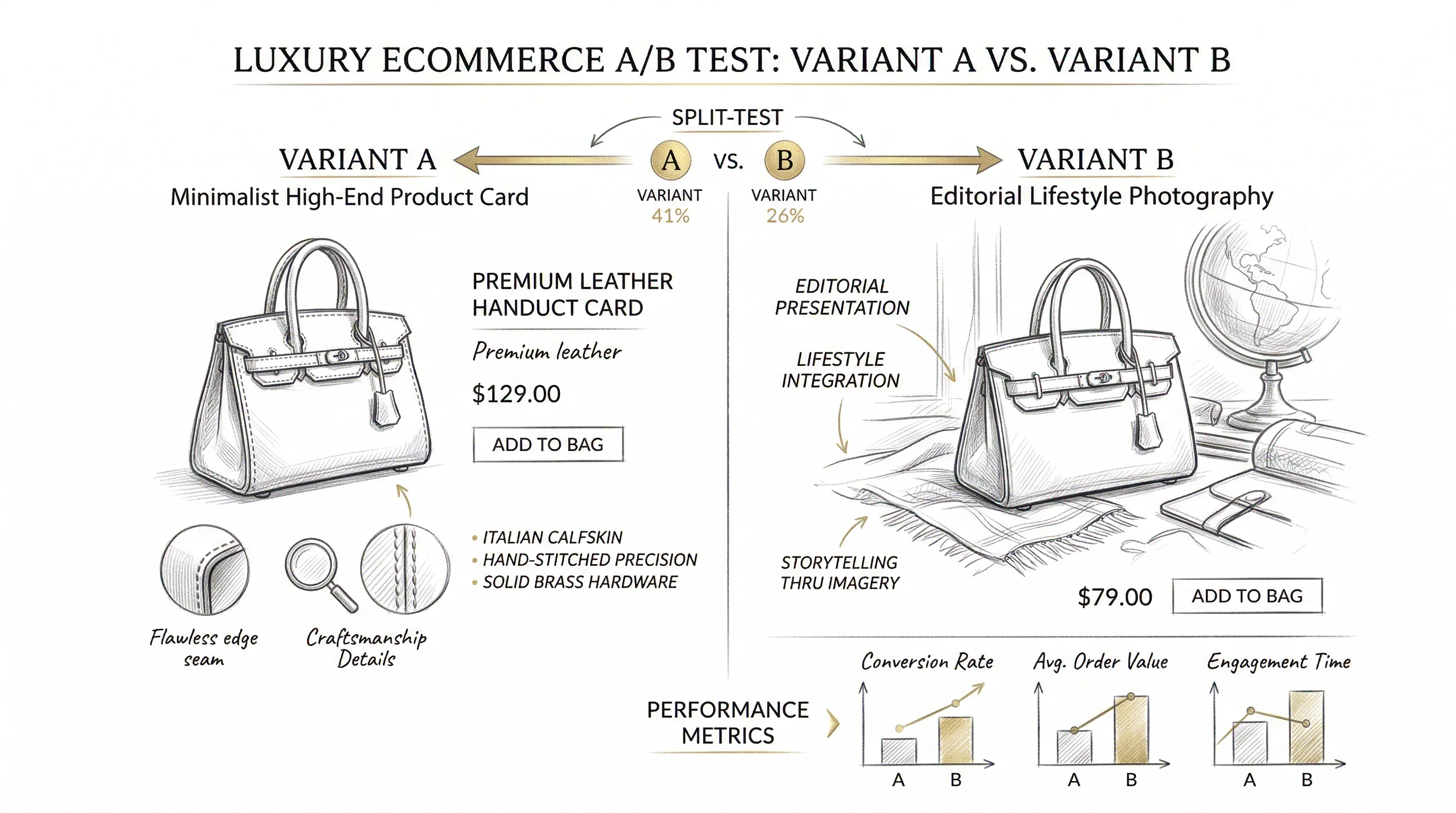
Related: homepage A/B testing ideas and 10 A/B test ideas for luxury & premium brands for complementary experiments.