From the conversion glossary
Concepts referenced in this article, defined.
Concepts referenced in this article, defined.
Run rigorous A/B tests and personalize every visit on Shopify or any storefront — no engineers required.
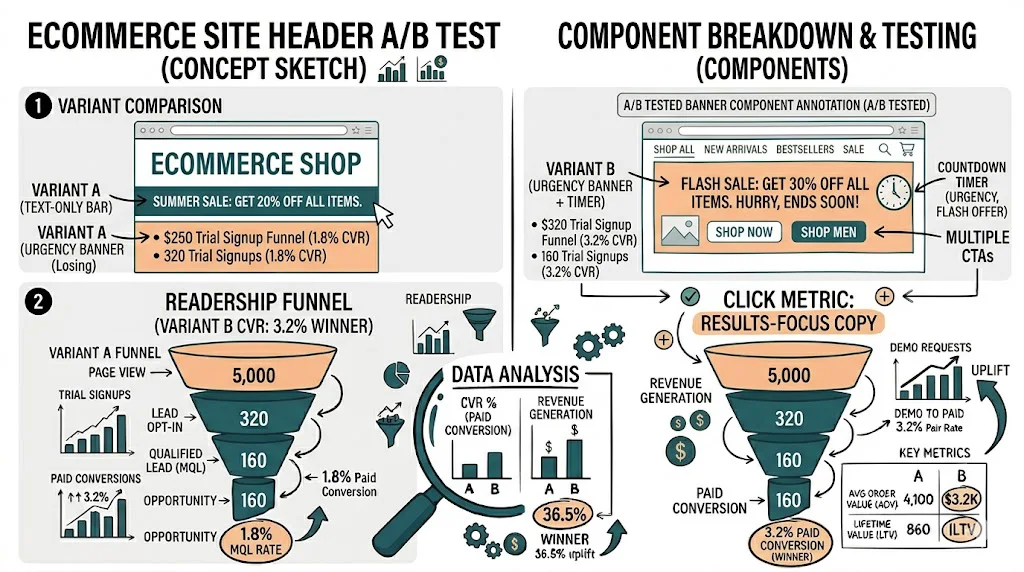
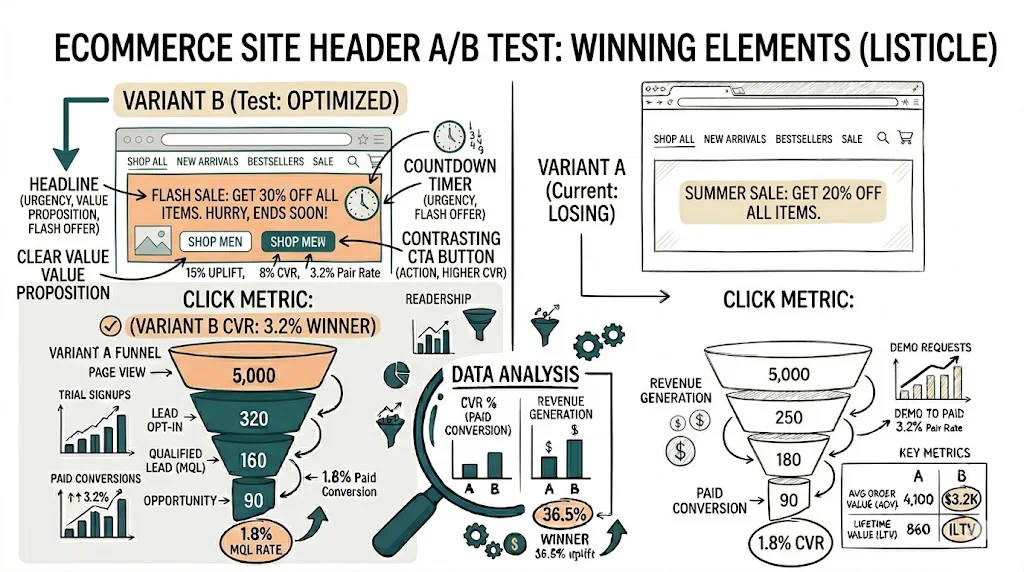
A/B testing banners means running controlled experiments on your homepage hero, category page headers, promotional strips, and announcement bars to determine which version drives more clicks, add-to-carts, and purchases. Banners are high-visibility, high-stakes real estate — the first thing a new visitor sees — so a winning banner test compounds across all new traffic to your store. For D2C ecommerce brands on Shopify, the highest-impact banner tests focus on headline copy, offer clarity, and CTA text rather than pure visual design.
The homepage banner is your store's first impression. In Indian ecommerce, where the Diwali, Holi, and end-of-season sale cycles drive large traffic spikes, banner effectiveness directly determines how many of those peak visitors convert.
Bellavita drove an 11% improvement in conversion rate through iterative testing — banners were part of the mix, as they set the offer expectation that either matched or contradicted what the product page delivered.
Banner tests are also fast to implement. Unlike navigation or checkout changes, you can build and deploy a banner variant in hours, making banners an ideal place for high-cadence experimentation.
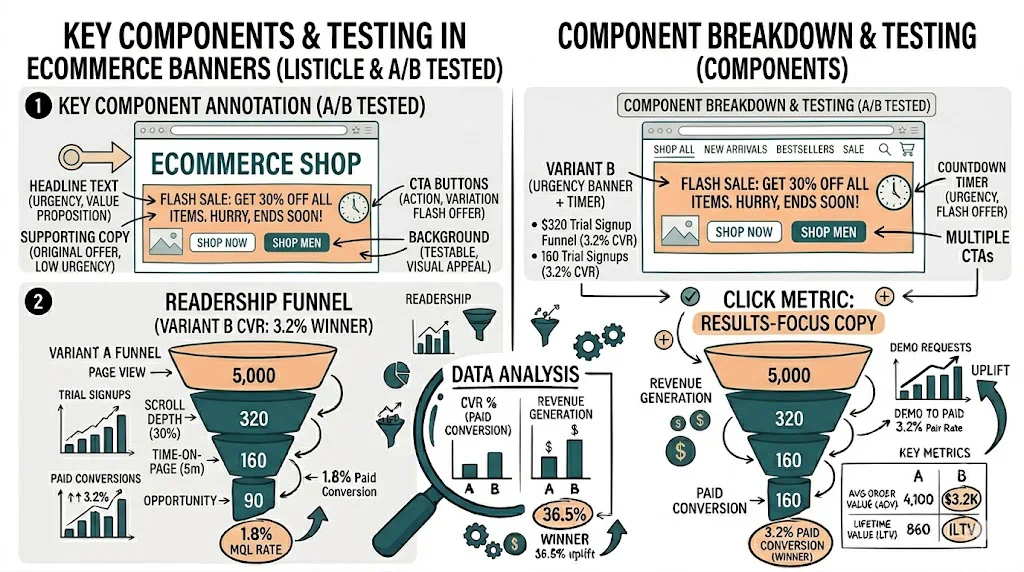
The primary banner, usually above the fold. This is the highest-traffic banner on your site and typically the most impactful to test.
What to test:
The thin strip at the very top of the page, used for free shipping thresholds, sale announcements, and urgency messaging.
What to test:
See Shopify Announcement Bar Optimization for a deeper treatment of this specific element.
Banners at the top of category pages can reinforce the offer or highlight subcategories.
What to test:
Banners placed within product grids or homepage sections to highlight specific promotions.
What to test:
Step 1: Identify your hypothesis Be specific. "Changing the hero banner headline from 'Flat 30% Off' to 'Free Delivery on Orders ₹499+' will increase homepage-to-product-page CTR by 15%."
Step 2: Choose your metric
Step 3: Build the variant With a no-code tool like CustomFit.ai, you can create and deploy a banner variant without developer help. On Shopify, banner changes can be made through the theme editor or via your CRO tool's visual editor.
Step 4: Check sample size Homepage banners have the highest exposure on your site, so they reach significance faster than most tests. At 10,000 monthly visitors and a 5% CTR baseline, detecting a 20% relative lift at 95% confidence takes about 4,000 visitors per variant — roughly 3-4 days for most mid-size D2C stores.
Step 5: Run and don't peek Set a calendar reminder for your target end date and resist checking daily. Checking results more than once per week inflates your false positive rate (see statistical significance).
Diwali, Holi, Navratri, Republic Day, and Independence Day sales are critical periods for Indian D2C brands. Banner strategy during these windows differs from evergreen testing:
Compressed test windows: You may have only 7-10 days. Run tests for the full window but accept that you may not reach full significance. Use the data directionally.
Higher traffic = faster significance: During Big Billion Days or Great Indian Sale periods, traffic spikes can halve your time to significance. Launch tests on Day 1 of the promotional window.
Test offer framing, not creative: During a sale, creative production time is limited. Focus tests on copy: "30% off" vs. "Biggest Sale of the Year" vs. "Prices Slashed — Shop Fast."
COD vs. prepaid offers: Indian ecommerce has high COD preference. Test whether "Pay Now, Save Extra 5%" messaging in the banner shifts payment mix and affects AOV.
Testing too many elements at once — Changing the image, headline, and CTA simultaneously in a single variant makes it impossible to know which element drove the result. Test one element at a time unless you use a full factorial design.
Using click-through rate as the only metric — A banner that gets more clicks but sends visitors to products they don't want will reduce conversion rate. Always track downstream metrics.
Not separating mobile from desktop — A banner variant with long copy may win on desktop but lose on mobile where text gets truncated. Segment by device before declaring a winner.
Running during an anomalous week — Launching a banner test during a sale event, festival, or product launch contaminates results. Run tests during "normal" traffic weeks unless you specifically want festive insights.
Related reading: A/B Testing Pillar | A/B Testing Navigation Menus | Shopify Announcement Bar Optimization | A/B Testing Video vs Images