From the conversion glossary
Concepts referenced in this article, defined.
Concepts referenced in this article, defined.
Run rigorous A/B tests and personalize every visit on Shopify or any storefront — no engineers required.
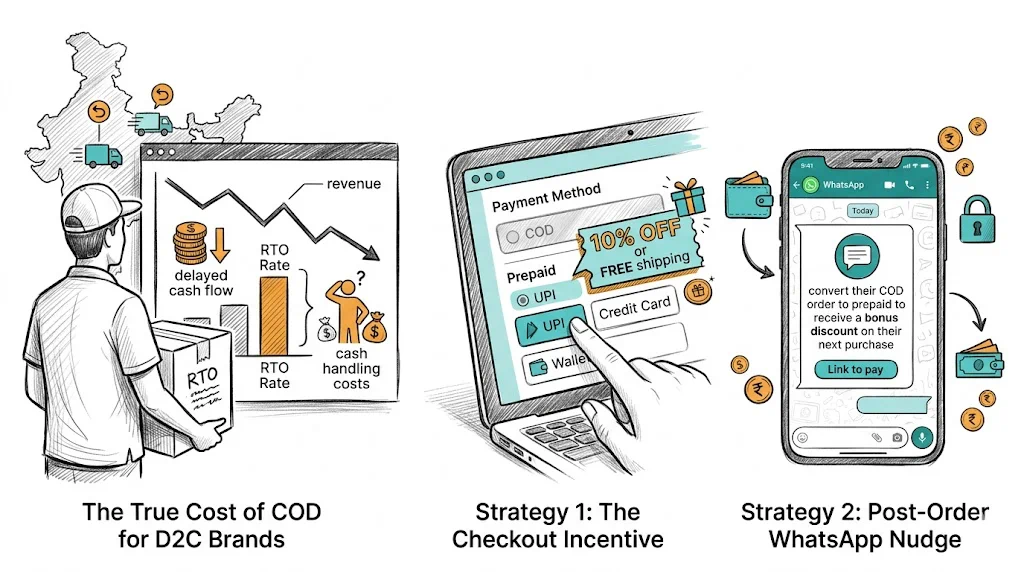
COD (cash on delivery) is one of India's most important D2C growth enablers — it lets first-time buyers purchase without prepayment risk. But it creates a significant operational burden: higher RTO (return-to-origin) rates, cash handling costs, delayed cash flow, and lower trust signals to fulfilment partners. COD to prepaid conversion is the practice of nudging COD-preferring buyers toward UPI, cards, or digital wallets — ideally on their first order or on repeat orders where brand trust is established. Done well, it improves your unit economics without damaging the customer relationship.
RTO (Return to Origin) rate: Prepaid orders have 5–10% RTO rates on average. COD orders from Tier 2/3 cities, or from first-time buyers in any region, have 20–40% RTO rates. Every RTO costs you two-way shipping plus the cost of holding the product during transit — often ₹150–₹300 per order.
Cash handling fees: Cash collection charges from logistics partners add ₹30–₹60 per order.
Delayed cash flow: COD payment is remitted by the logistics partner typically 7–14 days after delivery. For growing brands with tight working capital, this delay creates real cash flow pressure.
Fraud and fake orders: COD orders are easier to place fraudulently — no payment verification required. Some brands see fake order rates above 10% in certain geographies.
The opportunity: Converting even 20–30% of your COD orders to prepaid can meaningfully improve gross margin, cash flow, and fulfilment efficiency.
The most straightforward COD-to-prepaid conversion: offer a direct incentive at the payment selection step.
How it works: After the shopper selects shipping address (high purchase intent), show a highlighted offer above the payment options: "Pay now via UPI and save ₹50" or "Prepaid orders ship same day — COD ships next day."
Why it works: At the address stage, the shopper has psychologically committed to buying. The switch cost from COD to UPI is low — they just tap a different payment option. The incentive tips the balance.
What incentive to offer:
A/B test: Test ₹50 off vs. free express shipping vs. bonus sample. Measure prepaid conversion rate and whether the incentive affects repeat purchase behaviour (you want COD buyers to become prepaid repeat buyers, not one-time discount seekers).
After a COD order is placed, you have a 30-minute to 24-hour window before the order is packed and dispatched. In this window, you can offer the buyer a chance to switch to prepaid with an additional incentive.
Message structure: "Hi [Name], your [Product] order is confirmed! Switch to prepaid in the next 4 hours and save ₹75 — your order will also get priority packing. Pay via UPI: [link]"
This works because:
Timing matters: Messages sent within 30–60 minutes of order placement convert significantly better than those sent hours later, because purchase intent is still active.
First-time COD buyers may have high trust anxiety. But a buyer who placed a COD order 30 days ago, received the product, and was satisfied — that buyer's anxiety is resolved. They are now an ideal prepaid conversion target.
Targeting rule: Customer placed 1+ COD orders in the last 90 days. Show on their next visit:
This conversion is high-value because:
Use CustomFit.ai's personalisation to show these messages only to the repeat COD buyer segment — not to all visitors, which would confuse new shoppers who haven't bought yet.
For buyers who have used COD multiple times with high RTO history, some brands implement a soft friction approach: making COD slightly less convenient than prepaid at the address stage.
How it works:
This is a blunt instrument and should be used selectively — only for buyers with documented RTO history, not for all COD users.
Many Tier 2/3 city buyers who choose COD have never used UPI for ecommerce checkout, even if they use it for local payments. A brief "Pay via UPI" education moment — showing the PhonePe or Google Pay flow with a visual — removes the friction of the unfamiliar.
Implementation: A small "How to pay via UPI" tooltip or short GIF embedded next to the UPI payment option at checkout. Show it only to new visitors who have never completed a prepaid checkout on your store.
This reduces the cognitive barrier without requiring an incentive — effective for first-time UPI ecommerce users in smaller cities.
Track these metrics before and after your COD conversion programme:
| Metric | How to Calculate | Target Direction |
|---|---|---|
| Prepaid % of total orders | Prepaid orders ÷ Total orders | Increase |
| RTO rate overall | RTOs ÷ Shipped orders | Decrease |
| RTO rate by payment method | RTOs by COD and prepaid separately | COD RTO should fall as you convert low-quality COD |
| CAC by payment method | Marketing spend ÷ Prepaid new customers | Track for payback |
| CLV by payment method | LTV for COD-first vs. prepaid-first buyers | Prepaid buyers typically show higher CLV |
Don't push COD conversion too hard on first-time buyers. A first-time visitor from an untrusted traffic source who is already hesitant about buying will abandon if forced toward prepaid. Show the incentive as an option, not an obstacle.
Don't create a two-tier service experience. If COD buyers get demonstrably worse service (slower shipping, less support), you risk losing them entirely rather than converting them. The incentive for prepaid should be positive, not punitive.
Don't over-discount. If your incentive is too high (₹200 off on a ₹500 order = 40% discount), you're training buyers to use COD specifically to get the discount. Aim for incentives that cover the operational cost of COD (typically ₹50–₹100) but don't become a routine discount.
Related reading: Reduce Shopify Cart Abandonment: 12 Tactics | Ecommerce Holiday Optimization: Festive Season Playbook | How to Scale an Ecommerce Business in 2026