From the conversion glossary
Concepts referenced in this article, defined.
Concepts referenced in this article, defined.
Run rigorous A/B tests and personalize every visit on Shopify or any storefront — no engineers required.
India's festive season is the single largest revenue opportunity for D2C ecommerce brands — but it punishes the unprepared. Traffic surges 2–5x during peak festive weeks, and brands that haven't optimised their conversion rate, personalised their offers, and prepared their infrastructure for peak load typically see their festive CAC spike while CVR declines. This playbook covers how to prepare systematically — so your brand benefits from the traffic surge rather than being overwhelmed by it.
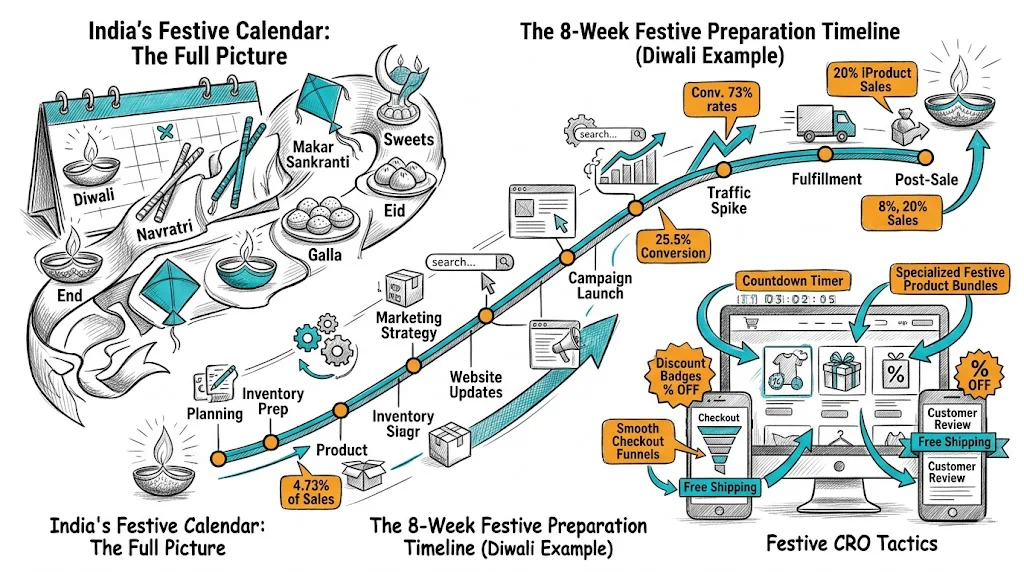
Unlike Western markets where Q4 is the single peak, India has multiple regional festive peaks spread across the year. Building a personalised festive calendar is the first step.
| Festival | Primary Regions | Approximate Dates | Peak Shopping Behaviour |
|---|---|---|---|
| Pongal | Tamil Nadu, South India | Jan 14–17 | Gift sets, food products, home goods |
| Holi | North/West India | March (varies) | Skincare protection, colour products, fashion |
| Eid ul-Fitr | Pan-India (focus: UP, Maharashtra) | April/May (varies) | Premium gifting, fashion, sweets |
| Eid ul-Adha | Same as above | June/July (varies) | Similar to Eid ul-Fitr |
| Raksha Bandhan | North/West India | August | Gifting, hampers, confectionery |
| Independence Day | Pan-India | August 15 | Patriotic campaigns, fashion |
| Onam | Kerala | August–September | Traditional products, gift hampers, Sadya |
| Navratri | Gujarat, Rajasthan, Maharashtra | September–October | Ethnic wear, footwear, festive beauty |
| Dussehra | North India | October | Fashion, electronics, lifestyle |
| Diwali | Pan-India (largest peak) | October–November | All categories, maximum volume |
| Christmas | South India, metros | December | Premium, gifting, electronics |
Key insight: A single "festive season" campaign running nationally from October to November misses Pongal, Holi, Eid, Onam, Navratri — five distinct peaks with hundreds of millions of high-intent buyers. Geo-personalised campaigns capture all of them.
Before the season, fix your foundation:
Diwali traffic is worth nothing if a 4-second load time and a broken checkout eat it.
This is your last chance to run clean A/B tests at normal traffic levels before the festive surge changes visitor intent and composition.
Priority tests to run:
Apply winners before the peak. Do not run new tests during peak weeks — festive traffic is too different from normal traffic for generalisable results.
Create dedicated landing pages for:
Test your festive landing page against your standard collection page using CustomFit.ai — in the 2 weeks before peak, festive-themed pages typically outperform generic ones by 15–30% in CVR for gift-intent traffic.
This is where personalisation compounds your festive investment.
Homepage personalisation:
Social proof localisation:
Implement these in CustomFit.ai using geo-targeting rules. Build them all in 1–2 days without developer involvement.
During Diwali, real scarcity is abundant — products genuinely sell out. Use actual stock signals: "Only 23 gift boxes left," "Last restock before Diwali," or "Delivery guaranteed before Diwali if ordered by [date]."
Pair urgency with a delivery date guarantee. "Get it by Dhanteras" or "Delivered before Diwali Puja" converts better than "Fast shipping available" because it answers the shopper's real question: will this arrive in time?
During festive season, a large percentage of purchases are gifts. Add a gift option at checkout: gift wrapping (₹49–₹99), gift message (free), or a gift receipt (without price). This unlocks gift-buyer purchases that might otherwise go to aggregators with better gift features.
Festive gifting is inherently bundle-oriented. Curated gift sets at ₹999, ₹1,499, and ₹2,499 price points capture buyers who want a complete gift without assembling individual items. These bundles typically lift average order value by 30–50% compared to individual product sales.
Test: curated bundle vs. "Build your own kit" vs. individual product pages for festive gift traffic.
10–14 days before your Diwali sale launch, run an early access campaign:
Early access creates genuine FOMO and pre-loads purchase intent before the main campaign launches.
Festive season often brings a wave of first-time buyers — many with COD preference. If your checkout defaults to UPI or card, you lose this segment.
Use personalisation to show COD first for new mobile visitors during the festive window. After the peak, return to your standard payment order for regular traffic.
During festive season, many shoppers buy gifts. Their biggest question: what if the recipient doesn't want it? A clear "30-day returns for festive purchases" policy — extended from your standard 14 days — removes a significant conversion barrier for gift buyers.
Festive season is also your biggest retention opportunity. The customers you acquire during Diwali can become year-round buyers if you treat them right in the weeks after.
Post-festive retention playbook:
Day 7 post-purchase: "How's your [product]? Here's how to get the most from it." A product usage guide that creates a positive first experience and preempts returns.
Day 21 post-purchase: A re-engagement email with a "Thank you for shopping with us during Diwali — here's an exclusive offer for your next order." Converting a festive buyer to a second-purchase is the cheapest acquisition you'll ever do.
Day 45–60: Replenishment reminder for consumable products. "Time for a top-up?" with a one-click reorder link.
Post-festive retargeting: The CAC for re-targeting festive buyers in November and December is dramatically lower than acquiring new customers because they're warm and brand-familiar.
Track these metrics separately for your festive peak vs. normal baseline:
Related reading: How to Scale an Ecommerce Business in 2026 | COD to Prepaid Conversion Strategies (India) | Geo-Based Personalization: Location-Aware Experiences