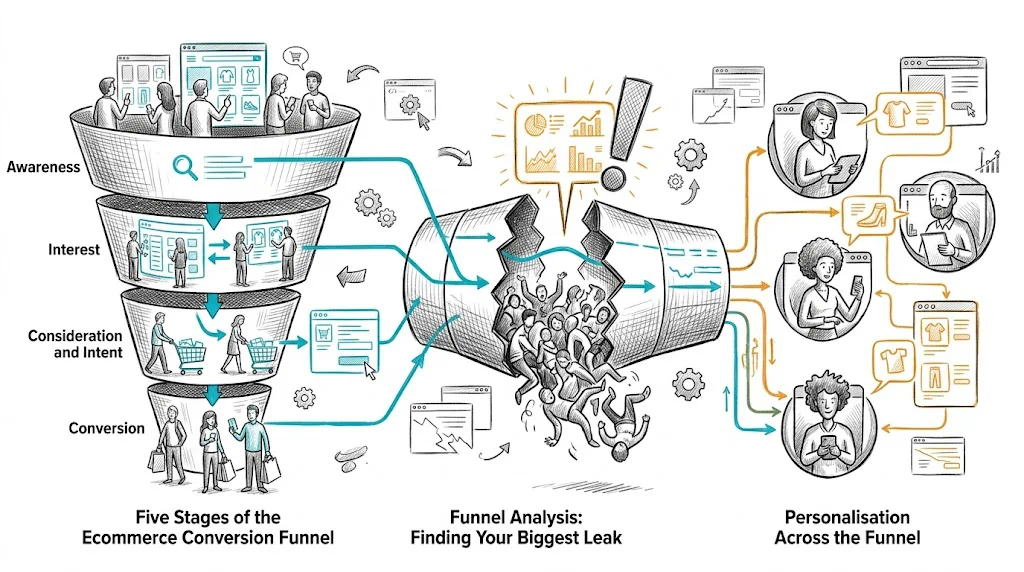
The ecommerce conversion funnel describes the path from a visitor's first impression of your store to their completed purchase. Optimising every stage of this funnel is how brands turn the same traffic into more revenue — without changing their ad spend, product quality, or pricing. Most stores lose 95–99% of their traffic before purchase. Understanding where and why they leave is the foundation of every effective conversion rate optimisation programme.
The Five Stages of the Ecommerce Conversion Funnel
Stage 1: Awareness — Visitor Arrives
The visitor lands on your site for the first time. They have a question: "Is this the right place for what I'm looking for?"
Metrics to track: Sessions, new visitor rate, bounce rate, traffic source
Key optimisations:
- Match landing page to ad creative. Visitors from an Instagram ad for a Vitamin C serum should land on the Vitamin C serum page — not the homepage. Mismatched landing pages cause immediate bounces.
- Page load speed. A page that takes 4+ seconds to load loses 30–40% of visitors before they see your product. Speed is a funnel stage in its own right.
- Immediate relevance. The hero section should communicate who you are, what you sell, and why it matters within 3 seconds. If a first-time visitor can't answer "Is this for me?" immediately, they leave.
Tools: Heatmaps and session recordings on your most common entry pages
Stage 2: Interest — Browsing Collections
The visitor decides to explore. They browse your collection pages, perhaps use the search bar, and start forming an opinion about whether your store has what they need.
Metrics to track: Pages per session, collection page CTR, search usage rate, time on site
Key optimisations:
- Category architecture. Can shoppers find what they're looking for in 2 clicks? If your navigation requires more than 2 levels or shows more than 8–10 categories, it's too complex.
- Product card information. Collection pages that show only the product image and name require the shopper to click into every product to evaluate it. Show star rating, key attribute (e.g., skin type suitability), and price on the product card.
- Search as a conversion driver. Shoppers who search convert at 3–5x the rate of those who browse. Make your search bar prominent and ensure your search engine returns relevant results, not just exact keyword matches.
- Personalised collection ordering. Returning visitors who consistently view one category should see that category's products first. Segmentation by browse history is one of the highest-ROI collection page optimisations.
Stage 3: Consideration — Viewing Product Pages
The visitor is evaluating a specific product. This is the most complex stage of the funnel — where the most information is needed and where the most buying decisions are made.
Metrics to track: Product page add-to-cart rate, scroll depth, video play rate, review engagement
Key optimisations:
- Social proof above the fold. Star rating and review count should be visible before any scrolling. Shoppers who see validation before they read the pitch convert 15–25% better.
- Complete product information. Size guide, ingredient list, delivery timeline, return policy — all available on the product page without navigating away.
- Video and UGC. A 15-second video showing real results converts better than studio photography for categories with high perceived risk (supplements, skincare, electronics).
- FAQ section. Pre-emptively answering the 5–8 most common purchase questions lifts CVR by 8–15% for high-consideration products.
- A/B testing. This stage has the most variables to test and the most uplift available. See Shopify Product Page A/B Testing Ideas.
Stage 4: Intent — Adding to Cart
The visitor has decided they want the product. Adding to cart is the critical micro-conversion that precedes purchase.
Metrics to track: Add-to-cart rate, cart-to-checkout rate, cart abandonment rate
Key optimisations:
- CTA prominence. The add-to-cart button must be the most visually prominent element on the product page. Competing visual elements reduce CTA click rate.
- Sticky CTA on mobile. A fixed add-to-cart bar that follows the mobile visitor down the page consistently lifts mobile add-to-cart rate by 8–20%.
- Shipping cost visibility. Show free shipping eligibility or shipping costs before the cart page. Surprising shoppers with shipping costs at checkout is the #1 cause of cart abandonment.
- Cart upsell. The cart page and cart drawer are the right moment for contextual cross-sell recommendations. "Customers who bought this also bought..." with relevant, not random, recommendations.
Stage 5: Purchase — Completing Checkout
The visitor has committed to buying and is completing the payment. This is where payment friction, trust deficit, and form complexity cause final abandonment.
Metrics to track: Checkout completion rate, payment success rate, checkout time
Key optimisations:
- Guest checkout. Never require account creation before purchase.
- Payment method diversity. Indian shoppers need UPI, COD, cards, and major wallets. Missing any of these creates a dropout point.
- COD for new visitors. New mobile visitors, especially from Tier 2/3 cities, convert better when COD is presented first.
- Trust signals at checkout. SSL badge, return policy, customer service contact — visible in the checkout flow.
- Autofill and minimal fields. Mobile checkout forms with autofill-enabled fields and minimal required data reduce completion time and dropout.
Funnel Analysis: Finding Your Biggest Leak
Your funnel is only as strong as its weakest stage. Use this framework to find where to focus:
Step 1: Set up a funnel report in Google Analytics 4 or Shopify Analytics tracking:
- Sessions → Product page views → Add to cart → Checkout initiation → Purchase
Step 2: Calculate the conversion rate between each stage:
- Session-to-product-view rate
- Product-view-to-ATC rate
- ATC-to-checkout rate
- Checkout-to-purchase rate
Step 3: Compare each rate to category benchmarks:
- Session-to-product-view: 40–60% is typical
- Product-view-to-ATC: 5–15% is typical
- ATC-to-checkout: 50–70% is typical
- Checkout-to-purchase: 60–80% is typical
Step 4: Focus on the stage with the largest gap from benchmark. This is your priority.
For most Indian D2C stores, the two biggest leaks are:
- Product page to add-to-cart (below 5% is very common — and fixable)
- Cart to checkout completion (below 40% suggests serious checkout friction)
Personalisation Across the Funnel
Personalisation improves every stage of the funnel by matching the experience to visitor context:
- Stage 1: Match landing page to traffic source (Instagram ad → product-specific page)
- Stage 2: Reorder collections based on browse history
- Stage 3: Show skin-type-relevant products; surface UGC from similar demographics
- Stage 4: Show COD prominently to new mobile visitors; geo-personalised shipping information
- Stage 5: Pre-fill saved information for returning customers; personalise payment order by visitor history
CustomFit.ai lets you deploy personalisation at every funnel stage without developer involvement.
Tips & Best Practices
- Optimise the biggest leak first — don't spread effort across all stages simultaneously.
- Measure revenue per visitor across the whole funnel — not just at checkout, because AOV changes at each stage matter.
- Segment your funnel by traffic source — paid social, organic search, and email bring different visitor qualities that create different funnel shapes.
- Run funnel analysis quarterly — funnel performance changes as your traffic mix changes.
- Use A/B testing to validate every funnel fix — assume your fix is wrong until the data proves it right.
Key Takeaways
- The ecommerce conversion funnel has five stages: Awareness, Interest, Consideration, Intent, and Purchase — each with distinct friction points and optimisation levers.
- Most Indian D2C stores leak primarily at Stage 3 (product page to add-to-cart) and Stage 5 (checkout completion).
- Funnel analysis reveals your biggest leak; systematic A/B testing fixes it.
- Personalisation improves every funnel stage by matching the experience to visitor context, intent, and location.
- CustomFit.ai covers personalisation and A/B testing across all five funnel stages from a single no-code platform.
Related reading: Ecommerce KPIs: 25 Metrics Every Store Should Track | How to Scale an Ecommerce Business in 2026 | Shopify Upsell & Cross-Sell Strategies