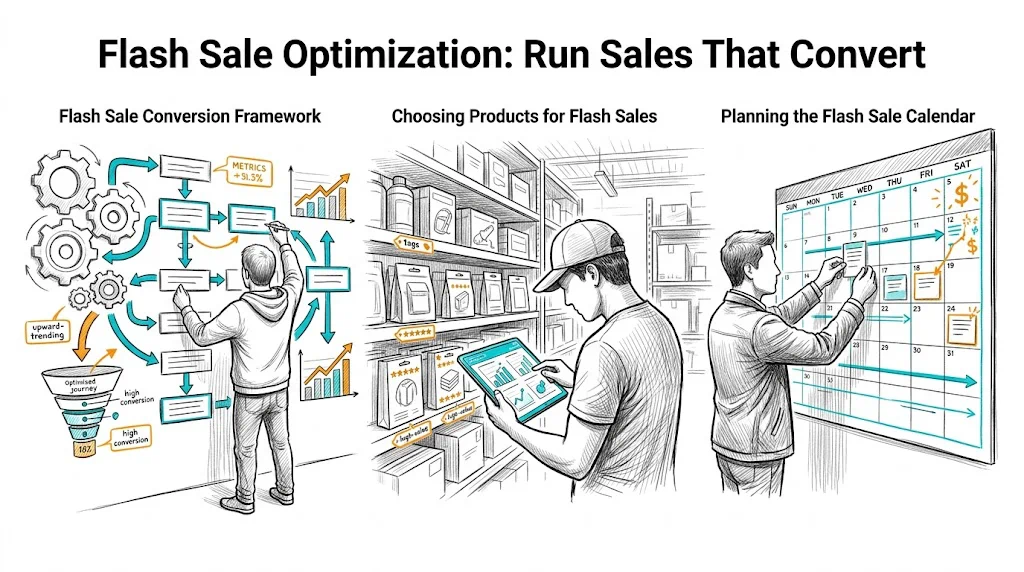
A flash sale that converts is not just a discount — it's a coordinated experience across traffic, landing pages, product selection, pricing, and checkout. Most brands run flash sales by lowering prices and sending an email. The brands that consistently generate 3–5x normal revenue from flash sales treat them as full-funnel optimization events. This guide covers how to design, launch, and optimize flash sales that convert — without destroying your brand's full-price positioning.
The Flash Sale Conversion Framework
A flash sale succeeds when it aligns four elements:
- Right offer — Products with strong perceived value at a meaningful (but not margin-destroying) discount
- Right audience — Customers and prospects who have already expressed interest in these products
- Right experience — Landing pages and checkout that handle spike traffic without friction
- Right urgency — Real, believable scarcity (time or quantity) that motivates action
Missing any one element kills the conversion. A great offer with a slow, confusing checkout converts poorly. A beautiful landing page with uninspiring products converts poorly.
Choosing Products for Flash Sales
Not every product should go on flash sale. The selection principle: choose products where a flash sale makes strategic sense.
Best flash sale products:
- Overstock items — Products you need to move. Genuine value for both sides.
- Hero product introductions — Launch a new product with a 72-hour introductory price
- High-margin products — Where a 20–30% discount still preserves healthy margins
- Bundle introductions — Create a flash-exclusive bundle that doesn't exist normally (makes the sale unique)
Products to protect:
- Flagship products — Repeated discounting trains customers to wait for sales and signals that the regular price is inflated
- Low-margin products — Further margin compression can make the sale revenue-negative
- Limited-edition or premium lines — Discounting damages the premium positioning
Planning the Flash Sale Calendar
India-Specific Flash Sale Moments
Indian D2C brands have built-in high-intent moments throughout the year:
| Period | Opportunity | Category Fit |
|---|
| Diwali (Oct/Nov) | Gifting, festive consumption | All categories |
| Republic Day (Jan 26) | Annual sale tradition | Fashion, electronics |
| Holi (March) | Beauty, colour, celebration | Beauty, fashion, food |
| End of Summer (May) | Season clearance | Fashion, appliances |
| Independence Day (Aug 15) | Patriotic + sale tradition | All categories |
| New Year (Dec 31–Jan 1) | Resolution-linked purchases | Wellness, fitness |
Flash sales tied to genuine occasions feel more authentic than arbitrary "48-hour sales."
Frequency Control
Limit flash sales to 4–8 per year. More frequent sales:
- Train customers to wait for discounts before buying
- Reduce the urgency of individual sale events
- Signal that your regular prices are inflated
Building the Flash Sale Landing Page
The flash sale landing page is its own CRO project. At minimum, test:
Countdown Timer
A real countdown timer (synced to server time, not fake) creates authentic urgency. Test:
- Timer placement (above product grid vs below hero vs in announcement bar)
- Timer design (minimal vs bold vs animated)
- "X items remaining" counter alongside timer for dual scarcity signal
Flash Sale-Specific Hero
Your generic collection page hero is not optimal for a flash sale. Create a dedicated hero with:
- Clear sale framing ("24-Hour Sale — Up to 40% Off")
- Sale end time prominently shown
- Product highlights with original vs sale price
- Primary CTA ("Shop Now — Sale Ends [Time]")
Test this dedicated hero against your regular collection header. Typically produces 25–40% lift in product click rates.
Product Grid During Flash Sales
Sort your flash sale grid by:
- Discount % (highest first) — Shows visitors your best deals immediately
- Units remaining (lowest first) — Creates scarcity pressure but can hide good deals on items with more stock
- Revenue optimization (highest-margin items first) — Best for business but not always best for conversion
A/B test sort order. Most brands find discount-first sort outperforms for external traffic; units-remaining sort works for email-warmed audiences who trust the brand.
Flash Sale-Specific Product Cards
Update product card design for the sale:
- Cross-through original price + red sale price
- "You save ₹X" callout
- "Only [X] left" badge when stock is genuinely low
- Countdown timer on individual product cards (for 4-hour sales)
Driving Traffic to Flash Sales
Email: Your Highest-Converting Channel
Email consistently outperforms paid ads for flash sale conversion because email subscribers have already opted in and expressed interest.
Flash sale email sequence:
- 24-hour preview — "Tomorrow: our biggest sale in 6 months. Be first."
- Sale launch — "It's live — 24 hours only. Here are our top picks."
- Midpoint nudge — "12 hours left — most popular items are selling out."
- Final hours — "Last chance — sale ends at midnight." (Only send if there's still inventory.)
Subject line testing for each email is its own A/B test worth running. "24-HOUR FLASH SALE" vs "Priya, we saved you ₹800" will produce meaningfully different open rates.
Push Notifications and WhatsApp
For D2C brands with app push or WhatsApp subscribers, these channels outperform email for time-sensitive flash sale alerts. The read rate for WhatsApp messages is 90%+ vs 20-25% for email.
Paid Retargeting
Retargeting ads to site visitors who viewed products that are now on sale convert extremely well during flash sales. These buyers already expressed interest; the discount closes the deal.
Personalization During Flash Sales
Flash sales are personalization opportunities:
- Returning buyers: Show products complementary to what they've already purchased
- Email click-through traffic: Highlight the specific product mentioned in their email
- High-value customers: Early access or exclusive additional discount
- Cart abandoners from previous sessions: Show those products at the flash sale price
Use UTM personalization and behavioral targeting to serve these segments automatically.
Post-Sale Analysis
Track these metrics for each flash sale:
- Revenue vs typical same-period revenue (lift)
- New customer % vs existing customer % (acquisition vs retention sale)
- Return rate on sale items vs regular items
- Repeat purchase rate from sale customers (are they valuable long-term buyers or one-time discount hunters?)
- Inventory depletion rate (did you run out too fast or have too much leftover?)
Post-sale analysis informs the next sale's product selection, pricing, and duration.
Tips / Best Practices
- Make scarcity real — Fake countdown timers and false "only 3 left" signals get noticed by frequent shoppers and destroy trust. Use real inventory and time limits.
- Optimize checkout capacity — Flash sales create traffic spikes. Ensure your checkout can handle 5–10x normal volume. Shopify handles this well; third-party checkout tools may not.
- Personalize flash sale emails by segment — A returning buyer of protein powder should see protein at the flash price, not a generic "sale starts now" message.
- Don't train customers to abandon carts pre-sale — If customers learn to add to cart and wait for a discount, your pre-sale full-price revenue suffers. Limit sale frequency.
- Test flash sale duration — 4-hour vs 12-hour vs 24-hour sales produce different behaviors. Shorter drives immediate action; longer reaches more of your audience.
- Include a post-sale thank-you sequence — Customers who bought during the flash sale are high-engagement. A post-sale email with usage content and a cross-sell (at regular price) often converts at higher rates than typical campaigns.
- Protect your email list from fatigue — Don't send 5 emails for a 4-hour flash sale. Over-emailing trains unsubscribes. 2–3 emails is the maximum for a single flash event.
Key Takeaways
- Flash sales convert when they have genuine scarcity, right product selection, a dedicated landing page experience, and personalized traffic delivery.
- Limit flash sales to 4–8 per year to preserve urgency and prevent discount-conditioning behavior.
- Email is the highest-converting channel for flash sales; a 3-email sequence (preview, launch, final hours) is the optimal structure.
- Post-sale analysis — especially new customer quality and repeat purchase rate — tells you whether your flash sale attracted valuable or discount-only buyers.
- Personalization during flash sales (segment-specific product highlights, UTM landing pages) significantly lifts conversion compared to generic sale pages.
Related reading: Customer Lifetime Value: Calculate & Optimize | D2C Growth Hacking: Low-Budget Strategies | Ecommerce Optimization Pillar