From the conversion glossary
Concepts referenced in this article, defined.
Concepts referenced in this article, defined.
Run rigorous A/B tests and personalize every visit on Shopify or any storefront — no engineers required.
Customer acquisition cost is one of the most important metrics in D2C ecommerce—and one of the most misunderstood. Many brands focus on reducing CAC by negotiating lower ad rates or finding cheaper channels. But the most powerful CAC reduction comes from improving what happens after the click: your conversion rate, your referral rate, and your organic acquisition. A ₹800 click that converts is cheaper than a ₹200 click that does not.
CAC = Total marketing and sales spend / Number of new customers acquired in the same period
Common mistakes in calculating CAC:
Calculate blended CAC (all channels combined) and channel-level CAC separately. Channel-level CAC helps you allocate budget; blended CAC is the number that matters for unit economics.
This is the highest-leverage CAC reduction tactic. If you spend ₹1 lakh/day on ads and acquire 100 customers, your CAC from ads is ₹1,000. Double your conversion rate and you acquire 200 customers for the same ₹1 lakh—CAC drops to ₹500.
Where to improve CVR:
Landing pages: Traffic from paid ads should land on dedicated landing pages optimized for the campaign's specific offer or product. A generic homepage for a specific product ad loses 30–50% of potential conversions.
Product pages: Clear benefit headline, social proof (reviews, UGC), variant display, delivery timeline. CustomFit.ai's no-code A/B testing lets you test these elements without developer involvement. Bellavita achieved 11% CVR improvement; Kapiva 9.48%.
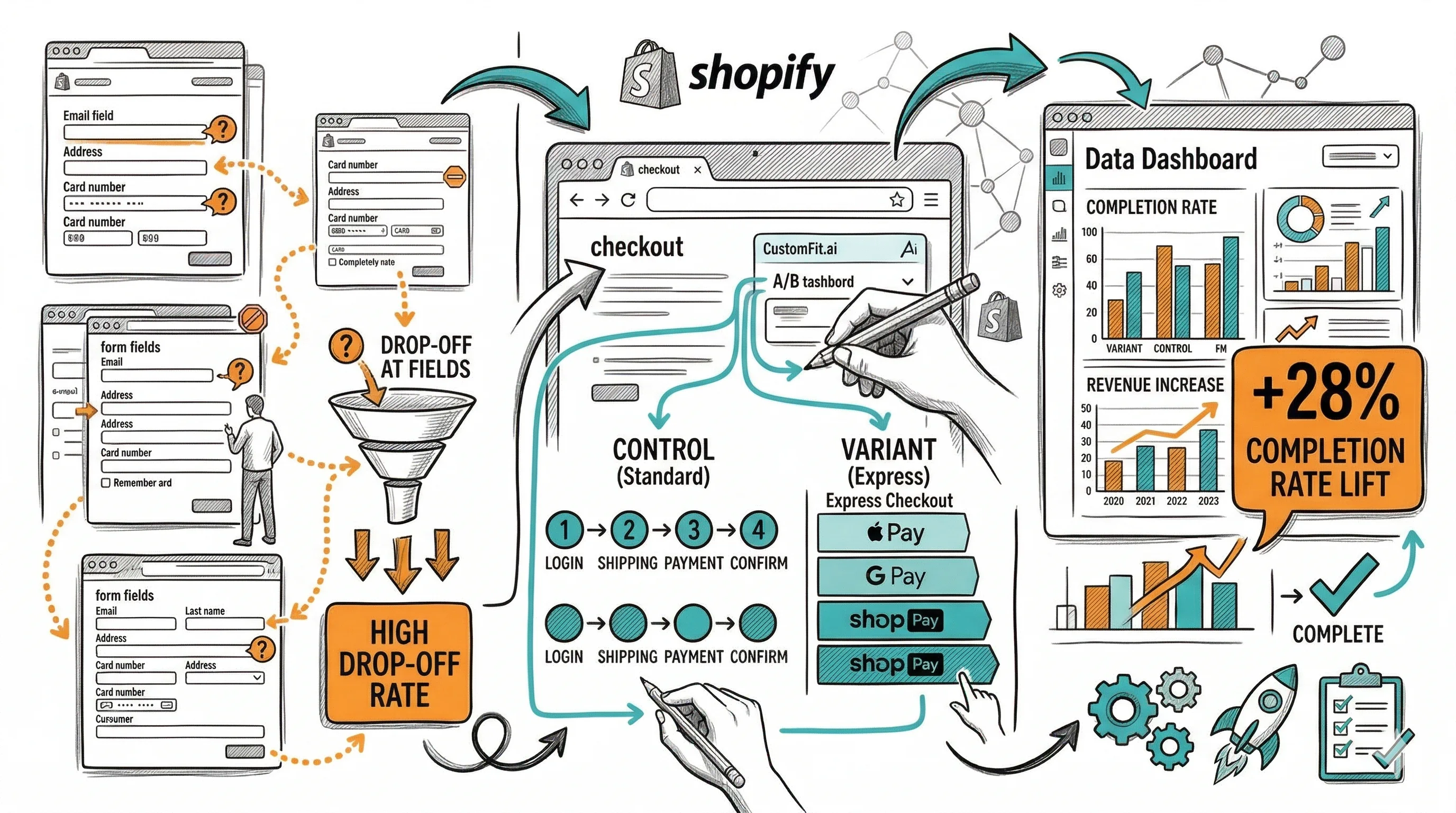
Checkout: Every additional field is a conversion drag. Minimize form fields, add UPI as the first payment option, show a prepaid incentive, and display trust badges near the payment section.
Site speed: Each additional second of page load time reduces conversion by 7–12%. Optimize images, remove unused Shopify apps, and use a fast theme.
Brands over-dependent on one channel (typically Meta ads) face rising CAC as competition for that channel's inventory increases. Channel diversification both reduces average CAC and reduces risk.
SEO and content marketing: Organic search has near-zero marginal CAC once content is ranking. A well-optimized product category page or buying guide that ranks on Page 1 for a high-intent keyword delivers customers at ₹0 marginal cost. The investment is upfront (content creation, link building), but the payoff compounds for years.
Email and WhatsApp: Building your own list reduces dependence on paid channels. A 50,000-person WhatsApp subscriber list can generate ₹5–₹15 lakh in revenue per broadcast at near-zero marginal cost.
Influencer marketing: At mid-funnel, micro-influencers (10K–100K followers) often deliver lower CPM than Meta ads with stronger trust signals. Track attributed orders with unique discount codes per influencer to measure true CAC.
Referral programs: A customer who refers another customer has near-zero CAC (just the referral incentive, typically ₹100–₹200). Referral program platforms like ReferralHero or GrowSurf make setup straightforward. A 5% referral rate across your customer base can contribute meaningfully to your acquisition volume.
Retargeting customers who have already visited your site or added to cart is typically 50–70% cheaper than cold acquisition. Yet many brands under-invest in retargeting relative to prospecting.
Retargeting audiences to build:
Retargeting creative: Different from prospecting ads. Retargeting ads should acknowledge prior intent: "You left something behind—here's ₹50 off to complete your order." Personalized retargeting based on specific products viewed outperforms generic brand retargeting.
CustomFit.ai can personalize your website for return visitors—showing the product they previously viewed with a subtle offer—creating a multi-touch retargeting experience that extends beyond just the ad.
A customer who buys once and never returns has a high effective CAC relative to revenue. Improving first-to-second order conversion rate reduces the effective CAC of your acquisition because you get more lifetime value from each acquired customer.
Tactics:
A brand that converts 35% of first-time buyers to a second purchase generates 75% more revenue per acquired customer than one converting 20%—without changing acquisition spend at all.
Better targeting means more of your ad spend goes toward people likely to buy, which improves both conversion rate and CAC.
Build strong lookalike audiences from your highest-LTV customer segments, not all purchasers. If your Tier 1 city female customers aged 25–35 buying skincare have 3x higher LTV than average, build lookalikes from that specific segment.
Exclude existing customers from prospecting campaigns—you are paying to reach people who already know you, lowering efficiency.
Use offline conversion tracking (Shopify → Meta Conversions API, Google Enhanced Conversions) so the ad platform algorithms can optimize toward actual purchases, not just website events.
Related reading: Conversion Rate Optimization | A/B Testing | Cart Abandonment | Ecommerce Loyalty vs Acquisition | Ecommerce Personalization Maturity Model
See also: D2C & Ecommerce Growth Pillar