CustomFit.ai โ€” Website personalization, A/B testing and CRO for Shopify and D2C
Product
Features
โœฑ
Website Personalization
Adapt to each visitor's behavior & intent
โง–
A/B & Multivariate Testing
Rigorous experimentation
โœจ
AI CopilotNEW
Personalize with a prompt
๐Ÿค–
AI WingmanNEW
Auto-optimize toward winners
๐ŸŽฏ
AI Conversion OptimizerNEW
GPT-grade test ideas
โœŽ
No-Code Visual Editor
Drag-and-drop edit any element
โ–ฆ
Product Recommendations
Personalized recs that lift AOV
โš‘
Feature Flags
Ship safely with kill-switches
โ—ง
Chrome Extension
Edit your store in the browser
โง‰
Shopify, WooCommerce & more
All platform integrations
View all features โ†’
Use Cases
$
Price A/B Testing
Test price points to maximize revenue
โ–ฆ
Theme A/B Testing
Compare whole layouts & designs
๐Ÿ—‚
Template A/B Testing
Test whole PDP/PLP templates
๐Ÿท
Discount A/B Testing
Find the offer that converts
๐Ÿšš
Shipping A/B Testing
Thresholds, speed & copy
โœ
Content A/B Testing
Copy, images & reviews
๐Ÿ’ณ
Checkout Gateway A/B
Payments & one-click
โŒ–
Geo-Based Personalization
Per-location content & offers
โšก
Buyer-Intent Nudges
Exit-intent & retargeting
โ†”
Split-URL / Redirection
Full-page redirect tests
View all use cases โ†’
Solutions & Guides
โคข
Conversion Rate Optimization
The complete CRO guide
โง–
A/B Testing Software
Buyer's guide for D2C
๐Ÿ›’
Cart Abandonment Recovery
Win back lost carts
๐Ÿ“ฐ
Landing Page Optimization
Convert more paid traffic
S
Shopify A/B Testing
Test your store, no code
S
Shopify Personalization
Tailor the store per shopper
โ—”
First-Time Visitor Offers
Convert new shoppers with trust & offers
โ˜…
Repeat-Customer Experiences
Reward and re-engage loyal buyers
โ—Ž
Campaign-Matched Pages
Match the landing page to the ad
โŒ–
Location-Based Experiences
Currency, language & regional offers
Explore CRO โ†’
Customer stories
GIVA
+32%
conversion via personalized recs
GIVA
Mamaearth
+18%
revenue lift from PDP A/B tests
ME
The Sleep Company
+24%
AOV from product recommendations
TSC
Read customer stories โ†’
Integrations
SWsfGA+15
โœฆ
Not sure where to start?
Let AI Copilot pick your first tests

โ€œWe wake up to evidence-backed tests ready to deploy โ€” not a backlog of maybe ideas.โ€

AN
Anirudh S.
Growth ยท Chargebee
โ˜…โ˜…โ˜…โ˜…โ˜…4.8on G2 ยท 2,400+ brands
Talk to our team โ†’
Widgets
Integrations
Ecommerce & Checkout
Shopify
Shopline
Shoplazza
GoKwik
ShopFlo
Razorpay Magic Checkout
Breeze
Shiprocket
View all integrations โ†’
Analytics & Behavior
Google Analytics 4
Microsoft Clarity
Hotjar
Mixpanel
Amplitude
Heap
Adobe Analytics
Segment (CDP)
View all integrations โ†’
Engagement, CRM & More
Klaviyo
MoEngage
CleverTap
WebEngage
HubSpot
Salesforce
Slack
Meta Ads
View all integrations โ†’
CustomersPricing
Resources
CRO
โ–ค
Playbooks
Proven strategies to boost conversions
๐ŸŽ™
Interviews
D2C leaders & marketing experts
โ–ถ
Webinars
Live deep dives & product sessions
Learn
โœŽ
Blog
Tips, experiments & best practices
๐Ÿ“•
Free E-Books
Mastering personalization
๐Ÿ“–
Conversion Glossary
Every CRO term, defined
โœฆAI CopilotNEWLog inBook a demo
Start free trial
Select your platform โ€” Install in 2 minsWe'll tailor the setup
โšก Risk-free 14-day trial ยท No credit card ยท Cancel anytime
S
Shopify
Install from Shopify App Store
โ€บ
W
WooCommerce
Install the WooCommerce plugin
โ€บ
B
BigCommerce
Install from BigCommerce App Marketplace
โ€บ
SL
Shopline
Install from Shopline App Store
โ€บ
M
Salesforce / Magento
Install from the marketplace
โ€บ
SZ
Shoplazza
Install from Shoplazza App Store
โ€บ
WP
WordPress / Webflow
Install plugin or paste the script
โ€บ
โ—ง
Others
Custom-built on React, Next.js, etc.
โ€บ
Tip: pick your platform โ€” we handle the restBook a demo โ†’
Product
Website PersonalizationA/B & Multivariate TestingAI CopilotAI WingmanAI Conversion OptimizerNo-Code Visual EditorProduct RecommendationsFeature FlagsView all features โ†’
Use Cases
Price A/B TestingTheme A/B TestingTemplate A/B TestingDiscount A/B TestingShipping A/B TestingContent A/B TestingCheckout Gateway A/BGeo-Based PersonalizationBuyer-Intent NudgesSplit-URL / Redirection
Solutions & Guides
Conversion Rate OptimizationA/B Testing SoftwareCart Abandonment RecoveryLanding Page OptimizationShopify A/B TestingShopify Personalization
Explore
WidgetsIntegrationsCustomersPricing
Resources
BlogPlaybooksWebinarsInterviewsE-BooksConversion Glossary
Platforms
ShopifyShoplineShoplazzaChrome ExtensionAll integrations
Start free trialBook a demo
Homeโ€บBlogโ€บexperimentationโ€บCRO Documentation: Templates & Best Practices

CRO Documentation: Templates & Best Practices

SJSapna JoharHead of Growth & CRO, CustomFit.aiJanuary 15, 202510 min read
On this page
  1. Why CRO Documentation Fails (And How to Prevent It)
  2. The Core CRO Documentation Templates
  3. Template 1: The Hypothesis Brief
  4. Template 2: The Test Results Report
  5. Template 3: The Test Log (Master Tracker)
  6. Template 4: The Hypothesis Backlog
  7. Template 5: The Monthly CRO Report
  8. Best Practices for CRO Documentation
  9. Using Documentation to Build Experimentation Culture
  10. Tips and Best Practices
  11. Key Takeaways
0%
CRO Documentation: Templates & Best Practices

From the conversion glossary

Concepts referenced in this article, defined.

Definition
What Is Hypothesis? Definition & Guide
Definition
What Is Variant? Definition, Formula & Guide
Definition
What Is Control? Definition, Formula & Guide
Definition
What Is Winner? Definition, Formula & Guide
Definition
What Is Sample Size? Definition & Guide
โ† Back to Experimentation guide
Try CustomFit.ai

Run A/B tests and personalize your store without code. 14-day free trial, no credit card.

Start free trial โ†’
Share
XLinkedInEmail

Related articles

experimentation

Testing Velocity: How Many Tests Should You Run?

Sapna Joharยท 8 min read
experimentation

Testing Culture: Getting Buy-In from Leadership

Sapna Joharยท 8 min read
experimentation

Quarterly CRO Review: What to Measure

Sapna Joharยท 8 min read

Start lifting conversions today.

Run rigorous A/B tests and personalize every visit on Shopify or any storefront โ€” no engineers required.

Start free trialBook a demo

Built for every D2C category

๐Ÿงด
Skincare
๐Ÿ’„
Beauty
๐ŸŒฟ
Wellness
โ˜•
F&B
๐Ÿ‘Ÿ
Apparel
๐Ÿ’
Jewelry
๐Ÿ›‹๏ธ
Home
๐Ÿผ
Baby
Live ยท Right now
Mamaearth โ€” free-shipping band +12.4% AOVGIVA โ€” festive collection page +34% revenueBellavita โ€” PDP CTA test +27.4% CVRKapiva โ€” Quiz-driven recs +9.48% CTRThe Sleep Co โ€” landing personalized 2ร— capturesPlum โ€” Returning shopper swap +18.2% CVRMamaearth โ€” free-shipping band +12.4% AOVGIVA โ€” festive collection page +34% revenueBellavita โ€” PDP CTA test +27.4% CVRKapiva โ€” Quiz-driven recs +9.48% CTRThe Sleep Co โ€” landing personalized 2ร— capturesPlum โ€” Returning shopper swap +18.2% CVR
Get in touch

Tell us about your store.

We reply within an hour during business hours. No sales pitch, no spam โ€” just answers from someone who's seen 2,400+ D2C stores.

โœ“ Reply within 1 hourโœ“ No spam, everโœ“ Free demo & setup help
โœ“ Thanks! We'll be in touch shortly.
CustomFit.ai

The all-in-one website personalization, A/B testing & CRO platform for high-growth D2C brands. Made by marketers, fueled by coffee.

in๐•โ—Žโ–ถf
Product
  • Features
  • A/B Testing
  • Personalization
  • AI Copilot
  • AI Wingman
  • AI Conversion Optimizer
  • Feature Flags
  • Widgets
  • Integrations
  • ROI Calculator
Platforms
  • Shopify
  • Shopline
  • Shoplazza
  • Salesforce
  • Chrome Extension
  • All Integrations
Resources
  • Blog
  • Playbooks
  • Webinars
  • GrowthFit Interviews
  • Free E-Books
  • Conversion Glossary
  • Case Studies
Compare
  • vs VWO
  • vs Optimizely
  • vs Google Optimize
  • vs Mutiny
  • vs Intelligems
  • vs Shoplift
  • vs AB Tasty
  • vs Convert
  • vs Kameleoon
Company
  • About Us
  • Partners
  • CustomFit Awards
  • Recognition
  • Contact
  • Privacy Policy
  • Terms & Conditions
ยฉ 2026 CustomFit.ai ยท Valley Monks Pvt Ltd ยท Made by marketers, fueled by coffee, and obsessed with conversions.
SOC 2 Type II ยท GDPR ยท CCPA ยท ISO 27001

A CRO program without documentation is a memory game. Tests get repeated, hypotheses get forgotten, and every team change resets the organization's learning. Documentation transforms your testing activity from a series of one-off experiments into a compounding knowledge base โ€” where every test builds on what came before and every new team member can immediately access the full history of what's been tried, what worked, and why. This guide provides ready-to-use templates and the practices that make documentation actually useful rather than just theoretically important.

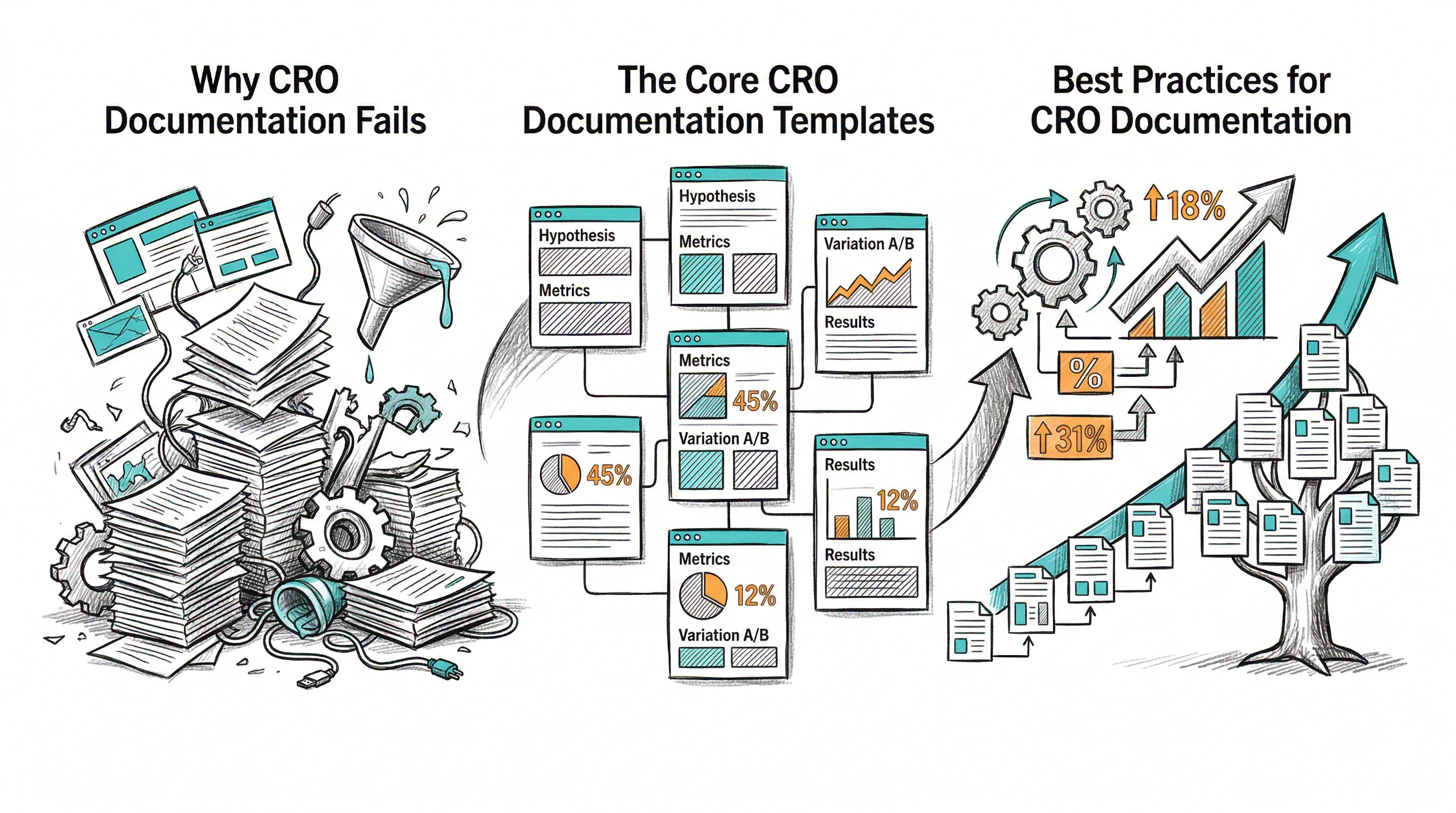
Why CRO Documentation Fails (And How to Prevent It)

Most CRO teams start with documentation intentions and abandon them. The reasons:

Too complex: A 15-field hypothesis template takes 45 minutes to fill out. Teams skip it when testing velocity is the priority.

Not searchable: Results stored in slide decks or scattered across email threads can't be searched. When you want to know "have we ever tested this?" you can't find out.

Not linked to outcomes: Documentation that captures what was tested but not what was decided or implemented becomes an orphaned archive.

No review cadence: Documentation that doesn't get read in regular team meetings becomes performative โ€” filled out to satisfy a process, not to drive learning.

The solution: simpler templates, a single source of truth, and a regular cadence where documentation is actively used.

The Core CRO Documentation Templates

Template 1: The Hypothesis Brief

Use this before launching any test. It forces clear thinking and creates a reference for post-test analysis.

HYPOTHESIS BRIEF

Test name: [Short descriptive name โ€” e.g., "Checkout trust badge โ€” return policy"]

Test ID: [Sequential number โ€” e.g., CRO-047]

Date created: [YYYY-MM-DD]

Test owner: [Name]

Page / Element: [URL or element description]

Observation: [What data, user research, or qualitative signal prompted this hypothesis?] Example: "Heatmaps show 62% of visitors exit the checkout page at the payment step. Exit survey data suggests 28% cite 'unsure about return policy' as their reason."

Hypothesis: "We believe that [change] will [improve/reduce] [metric] for [audience segment] because [reason based on evidence]." Example: "We believe adding a '30-day free returns' badge adjacent to the payment button will reduce checkout abandonment by 10โ€“15% for first-time buyers because the exit survey data indicates return policy uncertainty is a top objection at this step."

Control: [Description or screenshot URL]

Variant: [Description or screenshot URL]

Primary metric: [Single metric you'll use to determine winner โ€” e.g., checkout completion rate]

Secondary metrics: [Supporting metrics to track โ€” e.g., add-to-cart rate, revenue per session]

Traffic allocation: [50/50 | 70/30 | other โ€” and reason]

Target audience: [All visitors | new visitors only | mobile only | other segment]

Minimum sample size needed: [Calculate using a sample size calculator]

Planned runtime: [Minimum 2 weeks; calculated end date]

ICE/PIE Score:

  • Impact (1โ€“10): ___
  • Confidence (1โ€“10): ___
  • Ease (1โ€“10): ___
  • Total: ___

Template 2: The Test Results Report

Use this when a test concludes. Fill it out within 48 hours of stopping the test.

TEST RESULTS REPORT

Test name: [Same as hypothesis brief]

Test ID: [Same as hypothesis brief]

Dates: [Start date] โ†’ [End date]

Duration: [X days]

Total visitors: [Per variant and total]

Result:

  • Variant won
  • Control won
  • Inconclusive (didn't reach significance)
  • Test invalidated (technical issue / external event)

Primary metric outcome:

ControlVariantChange
[Metric]X%Y%+/- Z%

Statistical confidence: ___% (target: 95%)

Revenue / business impact (if implemented): "At current traffic levels, implementing this variant is estimated to generate โ‚น___/month in additional revenue."

Secondary metrics summary: [Did any secondary metrics move unexpectedly? Positively or negatively?]

Segment analysis: [Did the effect differ by device / traffic source / new vs. returning / geo?]

Hypothesis verdict:

  • Hypothesis confirmed
  • Hypothesis disproved
  • Mixed / partial confirmation

Key learning: In 2โ€“3 sentences: what did this test teach us about our customers' behavior?

Decision:

  • Implement variant (implementation by: ___ | Owner: ___)
  • Run follow-up test (next hypothesis: ___)
  • No action (reason: ___)

Next hypothesis generated: "Based on this result, we will next test ___ because ___."

Template 3: The Test Log (Master Tracker)

This is your single source of truth โ€” a spreadsheet or database where every test gets one row. All hypothesis briefs and results reports link back to this log.

Columns:

ColumnDescription
Test IDSequential (CRO-001, CRO-002...)
Test NameShort descriptive name
StatusPlanning / Live / Concluded / Implemented / Archived
PageURL or page type
ElementWhat was changed
PillarWhich CRO pillar (checkout / PDP / homepage / etc.)
HypothesisOne-sentence summary
Primary MetricWhat was measured
ResultWon / Lost / Inconclusive
Lift% improvement (blank if inconclusive)
Revenue Impact (โ‚น/mo)Estimated monthly impact
Confidence% statistical confidence
Start DateYYYY-MM-DD
End DateYYYY-MM-DD
Implemented?Yes / No / Pending
Implementation DateWhen the winner was deployed
OwnerTest owner name
NotesAny anomalies, caveats, links to deeper docs

This log should be reviewed weekly in your team meeting and monthly with leadership. The "Implemented?" column and "Revenue Impact" columns are the two most important for demonstrating program value.

Template 4: The Hypothesis Backlog

This is your pipeline โ€” tested ideas waiting to run, ordered by ICE/PIE score.

HYPOTHESIS BACKLOG

IDHypothesisPageElementImpact (1โ€“10)Confidence (1โ€“10)Ease (1โ€“10)ScoreStatus
H-022Adding a live chat button...CheckoutSupport widget87621Ready to test
H-023Showing ingredient origin story...PDPDescription76821Ready to test
H-024Free shipping threshold bar...CartProgress indicator88521Design needed

Score is the sum of Impact + Confidence + Ease. Work from the top of the list. Add new hypotheses at any time with their scores โ€” the list self-sorts.

Template 5: The Monthly CRO Report

A one-page summary of program performance, shared with leadership monthly.

CRO PROGRAM MONTHLY REPORT โ€” [Month Year]

Tests launched this month: X

Tests concluded this month: X

Winners implemented: X (___% implementation rate)

Estimated monthly revenue impact from implemented tests:

  • This month's implementations: โ‚น___/month
  • Cumulative from all implementations (program total): โ‚น___/month

Current tests live: [List with status]

Key learning this month: [1โ€“3 bullet points on what you learned โ€” about customers, about what works, about areas to explore]

Next month's priority tests: [2โ€“3 tests planned with one-line rationale for each]

Blockers: [Any constraints preventing velocity โ€” developer bandwidth, traffic limitations, data access]

Best Practices for CRO Documentation

One source of truth: All documentation lives in one place (Notion, Confluence, Google Drive โ€” pick one). No results in slides, no hypotheses in individual emails, no test logs in personal spreadsheets.

File every test, including null results: Tests that showed no winner are often more valuable than wins โ€” they eliminate directions. A searchable archive of null results prevents teams from re-running tests that already have answers.

Tag by element type: Create a tagging system (checkout, PDP, homepage, cart, navigation, email, mobile) so you can instantly filter the test log by area. When you're planning a new PDP test, you can immediately see all previous PDP tests and their outcomes.

Link results to decisions: Documentation that captures "the test won" but not "and we implemented it on [date]" is incomplete. The implementation column in your test log closes the loop.

Review documentation in team rituals: A weekly 30-minute "test review" where the team reads results aloud, discusses learnings, and prioritizes next tests ensures documentation is actively used โ€” not just filed.

Assign ownership clearly: Every test has one owner who is responsible for the hypothesis brief, the results report, and the implementation follow-through. Shared ownership is no ownership.

Using Documentation to Build Experimentation Culture

Documentation isn't just operational โ€” it's cultural. A well-maintained test archive tells the organization:

  • "We make decisions based on evidence, not opinion"
  • "We learn from every test, including the ones that don't win"
  • "Our knowledge compounds โ€” every new team member benefits from everything we've learned before they arrived"

When stakeholders propose changes based on gut feeling or competitor copying, a searchable test archive lets you say "We tested something similar in Q2 โ€” here's what we found." That's institutional knowledge creating better decisions.

CustomFit.ai's built-in test history and results tracking automates much of this documentation โ€” every test you run is automatically logged with traffic, variants, and results. You layer the qualitative documentation (hypothesis rationale, learnings, next steps) on top.

Tips and Best Practices

  • Write the hypothesis before, not after the test โ€” post-hoc hypothesis writing (fitting the explanation to the result) is a form of rationalization, not learning
  • Keep templates short enough to actually use โ€” a 5-field hypothesis template that gets filled out for every test is more valuable than a 20-field template that gets skipped
  • Export and back up your test log quarterly โ€” platforms change; your institutional knowledge should be portable
  • Create a "test idea submission" channel โ€” a Slack channel or form where anyone in the company can submit a hypothesis gives you a richer backlog and builds company-wide experimentation culture
  • Share wins publicly โ€” a brief company-wide note when a test wins and gets implemented ("Our checkout trust badge test won โ€” 14% more completions โ€” implementing this week") builds enthusiasm and contributions from outside the CRO team

Key Takeaways

  1. CRO documentation turns testing activity into compounding institutional knowledge โ€” without it, every team change and every hypothesis re-emerges from scratch
  2. Five core templates cover the full lifecycle: hypothesis brief, test results report, test log, hypothesis backlog, and monthly report
  3. Simple templates that actually get used are infinitely more valuable than comprehensive templates that get skipped
  4. Tag every test by page area and element type โ€” searchability is the primary value of a test archive
  5. Document null results as rigorously as wins โ€” they're often more valuable because they eliminate directions and prevent repeated tests
  6. Documentation used in team rituals (weekly review, monthly leadership report) drives action; documentation filed and never read drives nothing

Related reading: Experimentation Culture Pillar | CRO Pillar | Testing Velocity: How Many Tests Should You Run? | How to Present A/B Test Results to Stakeholders