CustomFit.ai โ€” Website personalization, A/B testing and CRO for Shopify and D2C
Product
Features
โœฑ
Website Personalization
Adapt to each visitor's behavior & intent
โง–
A/B & Multivariate Testing
Rigorous experimentation
โœจ
AI CopilotNEW
Personalize with a prompt
๐Ÿค–
AI WingmanNEW
Auto-optimize toward winners
๐ŸŽฏ
AI Conversion OptimizerNEW
GPT-grade test ideas
โœŽ
No-Code Visual Editor
Drag-and-drop edit any element
โ–ฆ
Product Recommendations
Personalized recs that lift AOV
โš‘
Feature Flags
Ship safely with kill-switches
โ—ง
Chrome Extension
Edit your store in the browser
โง‰
Shopify, WooCommerce & more
All platform integrations
View all features โ†’
Use Cases
$
Price A/B Testing
Test price points to maximize revenue
โ–ฆ
Theme A/B Testing
Compare whole layouts & designs
๐Ÿ—‚
Template A/B Testing
Test whole PDP/PLP templates
๐Ÿท
Discount A/B Testing
Find the offer that converts
๐Ÿšš
Shipping A/B Testing
Thresholds, speed & copy
โœ
Content A/B Testing
Copy, images & reviews
๐Ÿ’ณ
Checkout Gateway A/B
Payments & one-click
โŒ–
Geo-Based Personalization
Per-location content & offers
โšก
Buyer-Intent Nudges
Exit-intent & retargeting
โ†”
Split-URL / Redirection
Full-page redirect tests
View all use cases โ†’
Solutions & Guides
โคข
Conversion Rate Optimization
The complete CRO guide
โง–
A/B Testing Software
Buyer's guide for D2C
๐Ÿ›’
Cart Abandonment Recovery
Win back lost carts
๐Ÿ“ฐ
Landing Page Optimization
Convert more paid traffic
S
Shopify A/B Testing
Test your store, no code
S
Shopify Personalization
Tailor the store per shopper
โ—”
First-Time Visitor Offers
Convert new shoppers with trust & offers
โ˜…
Repeat-Customer Experiences
Reward and re-engage loyal buyers
โ—Ž
Campaign-Matched Pages
Match the landing page to the ad
โŒ–
Location-Based Experiences
Currency, language & regional offers
Explore CRO โ†’
Customer stories
GIVA
+32%
conversion via personalized recs
GIVA
Mamaearth
+18%
revenue lift from PDP A/B tests
ME
The Sleep Company
+24%
AOV from product recommendations
TSC
Read customer stories โ†’
Integrations
SWsfGA+15
โœฆ
Not sure where to start?
Let AI Copilot pick your first tests

โ€œWe wake up to evidence-backed tests ready to deploy โ€” not a backlog of maybe ideas.โ€

AN
Anirudh S.
Growth ยท Chargebee
โ˜…โ˜…โ˜…โ˜…โ˜…4.8on G2 ยท 2,400+ brands
Talk to our team โ†’
Widgets
Integrations
Ecommerce & Checkout
Shopify
Shopline
Shoplazza
GoKwik
ShopFlo
Razorpay Magic Checkout
Breeze
Shiprocket
View all integrations โ†’
Analytics & Behavior
Google Analytics 4
Microsoft Clarity
Hotjar
Mixpanel
Amplitude
Heap
Adobe Analytics
Segment (CDP)
View all integrations โ†’
Engagement, CRM & More
Klaviyo
MoEngage
CleverTap
WebEngage
HubSpot
Salesforce
Slack
Meta Ads
View all integrations โ†’
CustomersPricing
Resources
CRO
โ–ค
Playbooks
Proven strategies to boost conversions
๐ŸŽ™
Interviews
D2C leaders & marketing experts
โ–ถ
Webinars
Live deep dives & product sessions
Learn
โœŽ
Blog
Tips, experiments & best practices
๐Ÿ“•
Free E-Books
Mastering personalization
๐Ÿ“–
Conversion Glossary
Every CRO term, defined
โœฆAI CopilotNEWLog inBook a demo
Start free trial
Select your platform โ€” Install in 2 minsWe'll tailor the setup
โšก Risk-free 14-day trial ยท No credit card ยท Cancel anytime
S
Shopify
Install from Shopify App Store
โ€บ
W
WooCommerce
Install the WooCommerce plugin
โ€บ
B
BigCommerce
Install from BigCommerce App Marketplace
โ€บ
SL
Shopline
Install from Shopline App Store
โ€บ
M
Salesforce / Magento
Install from the marketplace
โ€บ
SZ
Shoplazza
Install from Shoplazza App Store
โ€บ
WP
WordPress / Webflow
Install plugin or paste the script
โ€บ
โ—ง
Others
Custom-built on React, Next.js, etc.
โ€บ
Tip: pick your platform โ€” we handle the restBook a demo โ†’
Product
Website PersonalizationA/B & Multivariate TestingAI CopilotAI WingmanAI Conversion OptimizerNo-Code Visual EditorProduct RecommendationsFeature FlagsView all features โ†’
Use Cases
Price A/B TestingTheme A/B TestingTemplate A/B TestingDiscount A/B TestingShipping A/B TestingContent A/B TestingCheckout Gateway A/BGeo-Based PersonalizationBuyer-Intent NudgesSplit-URL / Redirection
Solutions & Guides
Conversion Rate OptimizationA/B Testing SoftwareCart Abandonment RecoveryLanding Page OptimizationShopify A/B TestingShopify Personalization
Explore
WidgetsIntegrationsCustomersPricing
Resources
BlogPlaybooksWebinarsInterviewsE-BooksConversion Glossary
Platforms
ShopifyShoplineShoplazzaChrome ExtensionAll integrations
Start free trialBook a demo
Homeโ€บBlogโ€บexperimentationโ€บHow to Present A/B Test Results to Stakeholders

How to Present A/B Test Results to Stakeholders

SJSapna JoharHead of Growth & CRO, CustomFit.aiJanuary 15, 20258 min read
On this page
  1. The Core Problem: Statisticians Presenting to Business Leaders
  2. The BLUF Framework for A/B Test Presentations
  3. The Structure of a Clear A/B Test Results Presentation
  4. Slide 1: The Business Question
  5. Slide 2: What We Tested (Visually)
  6. Slide 3: The Results โ€” Business Impact First
  7. Slide 4: Statistical Confidence โ€” Simply
  8. Slide 5: Segment Breakdown (If Relevant)
  9. Slide 6: What We Learn and What We Do Next
  10. How to Present Null Results (When the Test Shows No Winner)
  11. Visualizing A/B Test Results
  12. Building Experimentation Credibility Over Time
  13. Tips and Best Practices
  14. Key Takeaways
0%
How to Present A/B Test Results to Stakeholders

From the conversion glossary

Concepts referenced in this article, defined.

Definition
What Is Hypothesis? Definition & Guide
Definition
What Is Variant? Definition, Formula & Guide
Definition
What Is Significance? Definition, Formula & Guide
Definition
What Is Control? Definition, Formula & Guide
Definition
What Is Statistical Significance? Definition & Guide
โ† Back to Experimentation guide
Try CustomFit.ai

Run A/B tests and personalize your store without code. 14-day free trial, no credit card.

Start free trial โ†’
Share
XLinkedInEmail

Related articles

experimentation

Testing Velocity: How Many Tests Should You Run?

Sapna Joharยท 8 min read
experimentation

Testing Culture: Getting Buy-In from Leadership

Sapna Joharยท 8 min read
experimentation

Quarterly CRO Review: What to Measure

Sapna Joharยท 8 min read

Start lifting conversions today.

Run rigorous A/B tests and personalize every visit on Shopify or any storefront โ€” no engineers required.

Start free trialBook a demo

Built for every D2C category

๐Ÿงด
Skincare
๐Ÿ’„
Beauty
๐ŸŒฟ
Wellness
โ˜•
F&B
๐Ÿ‘Ÿ
Apparel
๐Ÿ’
Jewelry
๐Ÿ›‹๏ธ
Home
๐Ÿผ
Baby
Live ยท Right now
Mamaearth โ€” free-shipping band +12.4% AOVGIVA โ€” festive collection page +34% revenueBellavita โ€” PDP CTA test +27.4% CVRKapiva โ€” Quiz-driven recs +9.48% CTRThe Sleep Co โ€” landing personalized 2ร— capturesPlum โ€” Returning shopper swap +18.2% CVRMamaearth โ€” free-shipping band +12.4% AOVGIVA โ€” festive collection page +34% revenueBellavita โ€” PDP CTA test +27.4% CVRKapiva โ€” Quiz-driven recs +9.48% CTRThe Sleep Co โ€” landing personalized 2ร— capturesPlum โ€” Returning shopper swap +18.2% CVR
Get in touch

Tell us about your store.

We reply within an hour during business hours. No sales pitch, no spam โ€” just answers from someone who's seen 2,400+ D2C stores.

โœ“ Reply within 1 hourโœ“ No spam, everโœ“ Free demo & setup help
โœ“ Thanks! We'll be in touch shortly.
CustomFit.ai

The all-in-one website personalization, A/B testing & CRO platform for high-growth D2C brands. Made by marketers, fueled by coffee.

in๐•โ—Žโ–ถf
Product
  • Features
  • A/B Testing
  • Personalization
  • AI Copilot
  • AI Wingman
  • AI Conversion Optimizer
  • Feature Flags
  • Widgets
  • Integrations
  • ROI Calculator
Platforms
  • Shopify
  • Shopline
  • Shoplazza
  • Salesforce
  • Chrome Extension
  • All Integrations
Resources
  • Blog
  • Playbooks
  • Webinars
  • GrowthFit Interviews
  • Free E-Books
  • Conversion Glossary
  • Case Studies
Compare
  • vs VWO
  • vs Optimizely
  • vs Google Optimize
  • vs Mutiny
  • vs Intelligems
  • vs Shoplift
  • vs AB Tasty
  • vs Convert
  • vs Kameleoon
Company
  • About Us
  • Partners
  • CustomFit Awards
  • Recognition
  • Contact
  • Privacy Policy
  • Terms & Conditions
ยฉ 2026 CustomFit.ai ยท Valley Monks Pvt Ltd ยท Made by marketers, fueled by coffee, and obsessed with conversions.
SOC 2 Type II ยท GDPR ยท CCPA ยท ISO 27001

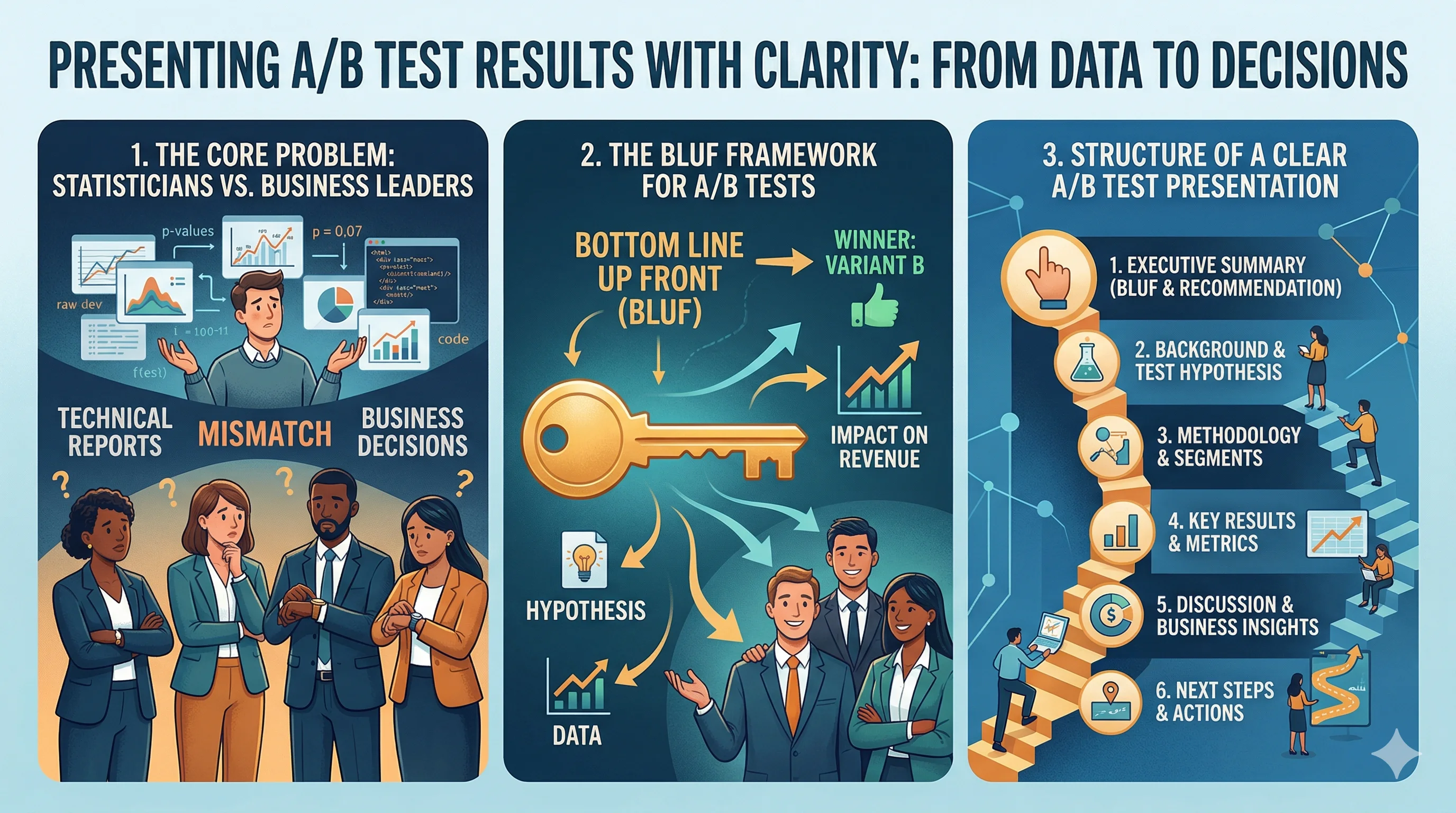
You ran a rigorous A/B test. The results are in. Now you need to turn statistical output into a business decision โ€” and you have 15 minutes in a leadership meeting with people who don't know what a p-value is. This is where many experimentation programs lose momentum: the tests are run well, but the results are presented in a way that doesn't drive action. This guide covers how to present A/B test results clearly, build stakeholder confidence in your experimentation program, and turn data into decisions.

The Core Problem: Statisticians Presenting to Business Leaders

Most A/B test presentations fail because they're structured for statistical credibility rather than business clarity. The presenter leads with methodology, then hypothesis, then data tables, then cautiously arrives at a conclusion buried in caveats. By the time the insight lands, the stakeholder has already disengaged.

Business leaders need to know:

  1. What question were we trying to answer?
  2. What did we find?
  3. What does it mean in business terms (revenue, conversions, orders)?
  4. What should we do next?

Structure your presentation around these four questions, in this order.

The BLUF Framework for A/B Test Presentations

BLUF: Bottom Line Up Front. Start with the conclusion, then the evidence. This is how executives and decision-makers prefer to consume information.

Template:

"We tested [what] on [page/element], targeting [audience/traffic split]. The result: [winning variant] increased [primary metric] by [X%], which translates to [โ‚น or unit impact per month]. We recommend implementing [variant] immediately. Here's the supporting data."

This opening in 30 seconds covers everything a stakeholder needs. The rest of the presentation is supporting evidence for the decision, not a suspense-building narrative.

The Structure of a Clear A/B Test Results Presentation

Slide 1: The Business Question

Start with why this test existed, connected to a business goal:

"We were seeing 68% cart abandonment on our checkout page. Our hypothesis: adding a 'Free returns within 30 days' trust badge near the payment button would reduce hesitation and lower abandonment."

Frame the test in terms of a problem the stakeholder cares about โ€” abandonment rate, revenue per session, conversion rate โ€” not in terms of a design or UX change.

Slide 2: What We Tested (Visually)

Show the control and the variant side by side. A screenshot comparison is worth 10 slides of description. Keep it simple: "This was the control. This was the variant. The only change was X."

If you changed multiple elements, acknowledge it: "We changed the button color and the CTA copy together. This was a multivariate test โ€” we can isolate individual effects in the next round."

Slide 3: The Results โ€” Business Impact First

Lead with the business metric, not the statistical one.

Bad: "The variant showed a conversion rate of 3.84% vs. the control's 3.38%, with a p-value of 0.032 at 95% confidence."

Good: "Checkout conversions improved by 14%. At our current traffic levels, that's approximately 200 additional completed orders per month โ€” or โ‚น1.8 lakh in additional monthly revenue."

Give stakeholders a number they can anchor on. The percentage improvement is useful, but the โ‚น or unit impact is what drives decisions.

Slide 4: Statistical Confidence โ€” Simply

You need to include statistical validity, but you don't need to teach statistics:

"We ran the test for 3 weeks with 8,400 visitors per variant. The result is 96% statistically significant โ€” meaning there's only a 4% chance we're seeing random variation rather than a real effect."

If the result isn't statistically significant, say so clearly: "The test ran for 2 weeks but didn't reach significance. We need 2 more weeks of data or a larger traffic allocation before we can conclude anything."

Slide 5: Segment Breakdown (If Relevant)

For tests with large traffic volumes, show whether the result held across key segments:

  • Did mobile users respond the same as desktop users?
  • Did the effect hold for new visitors AND returning visitors?
  • Did it hold across traffic sources (search vs. social vs. direct)?

Segment breakdowns that show the effect is consistent increase stakeholder confidence. Segment breakdowns that show heterogeneity (worked for mobile, didn't for desktop) give you the next hypothesis.

Slide 6: What We Learn and What We Do Next

Close every A/B test presentation with two things:

What we learned: "This confirms that return policy information is a meaningful hesitation point at checkout. It also suggests that our buyers' price sensitivity is lower than we assumed โ€” the trust badge mattered more than another discount."

What we do next: "We're implementing the winning variant this week. We're also testing a 'Chat with us' option at checkout to address the 12% of sessions where buyers still exit after seeing the badge."

This structure โ€” learning + next hypothesis โ€” signals that your experimentation program is a continuous learning system, not a one-off project.

How to Present Null Results (When the Test Shows No Winner)

Null results are not failures. They're information. Every failed hypothesis eliminates a direction and tightens the search for what actually works.

How to frame it:

"Our hypothesis was that a red CTA button would outperform the current blue. After 4 weeks and 22,000 sessions, we found no statistically significant difference. The button color is not the constraint here โ€” our next hypothesis is that the CTA copy is the issue, specifically 'Proceed to Checkout' vs. 'Complete my Order.'"

What not to say: "The test didn't work." What to say: "The button color doesn't matter โ€” now we know where to look instead."

Experimentation teams that present null results confidently, with a clear next hypothesis, build far more stakeholder trust than teams that present only wins. Leaders who only see winning tests eventually realize they're not seeing the full picture.

Visualizing A/B Test Results

Good visualizations make results undeniable and memorable:

Conversion rate bar chart: Simple before/after comparison. Control CVR vs. Variant CVR. Include the % uplift as a label.

Revenue impact calculator: A simple table showing: Current daily orders ร— uplift = additional orders per day ร— AOV = additional daily revenue ร— 30 = monthly revenue impact.

Timeline chart: Show how the metrics evolved over the test period. This helps stakeholders see that you didn't stop the test prematurely (a common concern) and that the trend was stable.

Segment heatmap (for complex results): A grid showing the effect size across key dimensions (device ร— traffic source, or new vs. returning ร— geo) helps identify whether the winning variant works universally or only for specific segments.

Avoid: raw data tables with 15 columns of numbers. If a stakeholder needs a data table, include it in the appendix.

Building Experimentation Credibility Over Time

Single A/B test presentations are less important than building a pattern of credibility across many tests. Here's how to do that:

Maintain a public test log: A shared document (or a tool like CustomFit.ai's test history) where anyone can see what's been tested, what won, what didn't, and what was implemented. Transparency builds trust.

Track implementation rate: What percentage of winning tests actually get implemented? A high win rate with low implementation signals that the CRO team is running tests but not driving change. Track this metric and present it to leadership.

Show compounding impact: After 6 months, sum the cumulative revenue impact of all implemented winners. "Our 8 implemented tests from Q3 are generating an estimated โ‚น12 lakh per month in additional revenue." This is the number that secures budget and team headcount.

Credit the hypothesis chain: "This winning test was inspired by the null result we got in August โ€” we learned X and tested Y, which won." This narrative of connected learning is what turns a testing program into an experimentation culture.

Tips and Best Practices

  • Send a pre-read before the meeting โ€” share the one-page results summary 24 hours before the presentation so stakeholders can arrive with questions rather than spending the meeting absorbing basics
  • Bring a clear recommendation โ€” never end a results presentation with "so, what do you all think?" Have your recommendation ready, even if it's "we need 2 more weeks"
  • Connect test results to OKRs โ€” "This test directly addresses our Q4 CVR OKR; implementation would put us on track for the target" makes resource allocation decisions easy
  • Acknowledge uncertainty honestly โ€” "This result is strong but our sample size was on the low end; we'd recommend monitoring for 2 weeks post-implementation before scaling" is more credible than false certainty
  • Use statistical significance language accessibly โ€” "95% confident" lands better than "p < 0.05" for non-statistician audiences

Key Takeaways

  1. Lead with business impact (revenue, orders, CVR change), not statistical methodology โ€” stakeholders need the conclusion first
  2. The BLUF structure (Bottom Line Up Front) is the most effective format for results presentations in business contexts
  3. Null results are information, not failures โ€” present them confidently with a clear next hypothesis to build credibility
  4. Show segment breakdowns to demonstrate that the effect holds across key dimensions (device, traffic source, visitor type)
  5. Every presentation should close with "what we learned" and "what we test next" to position experimentation as a continuous learning system
  6. Track and present the cumulative revenue impact of implemented winners โ€” this is the number that secures ongoing investment in your experimentation program

Related reading: Experimentation Culture Pillar | A/B Testing Pillar | Testing Velocity: How Many Tests Should You Run? | Statistical Significance | A/B Testing