From the conversion glossary
Concepts referenced in this article, defined.
Concepts referenced in this article, defined.
Run rigorous A/B tests and personalize every visit on Shopify or any storefront — no engineers required.
Product badges are small, but their impact on conversion is anything but small. The right badge at the right moment answers a buyer's silent question — "Is this product worth it? Is it safe? Am I making the right choice?" — in a fraction of a second. The best D2C brands treat badges not as design elements but as targeted conversion tools, A/B testing placement, copy, and timing to find what actually lifts sales. This guide covers every major badge type, how to use them, and how to test them effectively.
Badges work because they short-circuit the analytical part of the buying decision and appeal to instinct:
The key is matching the badge to the buyer's current objection. A new visitor needs trust. A returning visitor considering a purchase needs social proof or urgency. A buyer comparing prices needs value messaging.
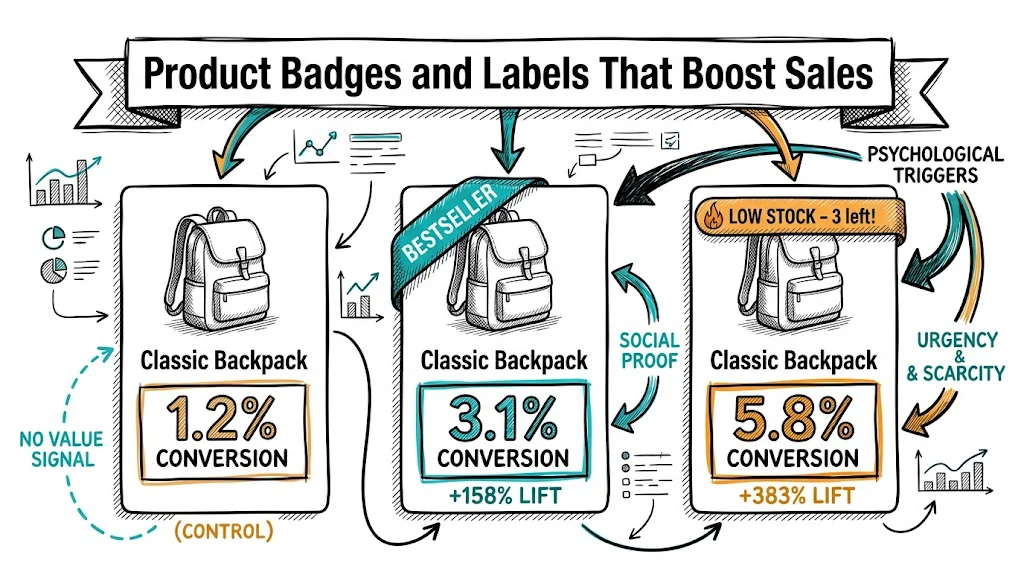
These tell buyers that other people have already made the decision they're considering:
When to use: On collection pages to guide discovery, and on PDPs for any product with strong review volume. Don't show "Bestseller" on a product with fewer than 50 reviews — it will feel unearned.
These create the conditions for a decision now rather than later:
When to use: On high-intent pages (PDP, cart) for buyers who are clearly considering the product. Never fake scarcity — Indian buyers are increasingly savvy and will notice if "Only 3 left" never changes.
These reduce the perceived risk of buying, especially for health, beauty, and food products:
When to use: Near the product title, on the hero image, and adjacent to the add-to-cart button for products where safety and quality are primary purchase considerations.
These signal that the buyer is getting a good deal:
When to use: On sale products, bundle offers, and during festive season campaigns. Use flat amount (₹200 off) for items priced under ₹2,000 — it feels more tangible than a percentage.
These draw attention to what's fresh:
When to use: On collection pages and in the first two weeks of a product launch. Refresh seasonal badges promptly — a Diwali badge in February signals neglect.
Placement is as important as badge type. Test these three locations:
On the product image (top-left or top-right corner): This is the most common placement. Badges here are visible immediately on both collection pages (thumbnail view) and the PDP hero. "Bestseller" and "Sale" badges work especially well here.
Next to the product title: Inline badges (small, text-based, often a chip or pill design) placed next to or just below the title are read as part of the product information. Trust and quality badges ("Lab tested," "Award winner") are most effective here.
Adjacent to the add-to-cart button: This is the highest-intent placement — the buyer is about to make a decision. Urgency ("Only 2 left"), social proof ("50 people bought this today"), and trust badges at this location directly address last-moment hesitation.
Don't just add badges and hope for the best. Run structured A/B tests to know what's actually driving conversion:
Test 1: Badge type — Control (no badge) vs. "Bestseller" vs. "Only 3 left" vs. "Lab tested." Use your highest-traffic PDP for this test; you need sufficient volume to reach statistical significance.
Test 2: Placement — Same badge in three positions: on the image, next to the title, adjacent to the add-to-cart button.
Test 3: Copy — "Only 5 left" vs. "Selling fast" vs. "Limited stock" — subtle copy differences can move CVR by 5–8%.
Test 4: Color — Red urgency badges vs. green trust badges vs. neutral value badges. High contrast with your page background is important; the badge needs to be noticed without clashing with the design.
Test 5: Collection page vs. PDP — Does showing a "Bestseller" badge on the collection page lift clicks to the PDP? Does it lift overall collection page conversion?
CustomFit.ai lets you run all of these tests without a developer — build a variation, target the right audience, and let the data decide.
COD and payment badges: A "COD available" badge on product images — especially for Tier 2/3 city traffic — can lift conversion for first-time buyers who don't trust prepayment. Test adding "Pay on delivery" to your trust badge cluster.
Festival-specific badges: During Diwali, Holi, or Eid, "Festival special" and "Gift ready" badges on relevant products drive seasonal conversions. Create these ahead of each season and A/B test their placement.
Made in India / Locally sourced: For Indian D2C brands, a "Made in India" or "100% Indian ingredients" badge resonates strongly with a growing cohort of conscious buyers. This is both a trust and identity signal.
Review count thresholds: Display review count badges only after reaching meaningful volume. "47 reviews" is less persuasive than "4,000+ reviews." Consider showing the star rating prominently and the review count inline.
Related reading: Product Page Optimization Pillar | Product Comparison Tables: Design & A/B Test | Social Proof | A/B Testing