From the conversion glossary
Concepts referenced in this article, defined.
Concepts referenced in this article, defined.
Run rigorous A/B tests and personalize every visit on Shopify or any storefront — no engineers required.
Every rupee you spend acquiring traffic is a sunk cost the moment a visitor lands on your store. The question is: how much of that visit turns into revenue? For most Indian D2C brands, the answer is 1–3% — meaning 97–99% of paid traffic generates no return. Increasing ecommerce revenue without more traffic means fixing that ratio. This guide covers the three proven levers: conversion rate, average order value, and retention — and exactly how to move each one.
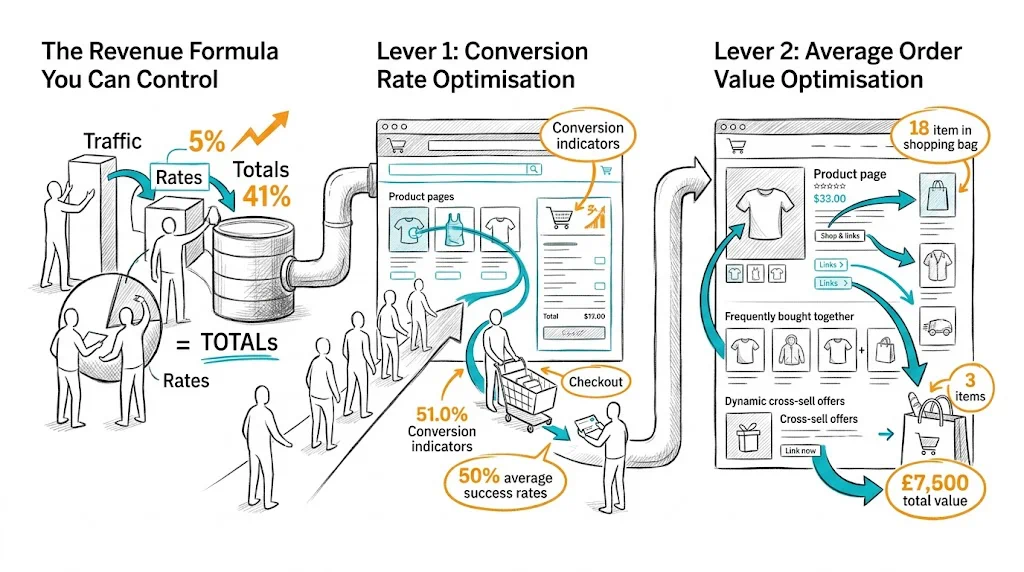
Revenue = Visitors × Conversion Rate × Average Order Value
You control conversion rate and AOV directly. Traffic is largely determined by ad spend and organic performance. But conversion rate and AOV improvements make every unit of traffic worth more — which means you can grow revenue without growing spend, or grow revenue faster than spend for the same investment.
A practical example:
Same traffic. 83% more revenue. This is what structured CRO produces.
Before you can fix conversion rate, you need to know where visitors are dropping. Build a funnel in Google Analytics 4 or Shopify Analytics:
Sessions → Product page views → Add to cart → Checkout → Purchase
The stage with the biggest percentage drop is your starting point.
Most common friction points for Indian D2C:
Move social proof above the fold. If your star rating and review count are below the product description, move them directly under the product name and price. This change alone can lift add-to-cart rate by 10–25% for high-consideration products.
Add a sticky add-to-cart bar on mobile. A fixed bar at the bottom of the screen — always visible during scroll — removes the need for mobile visitors to scroll back up to buy. Typical lift: 8–20% mobile add-to-cart rate.
Show COD prominently for new visitors. New mobile visitors from Tier 2+ cities prefer COD overwhelmingly. If it's buried after UPI and cards, these visitors abandon at checkout. Use personalisation to surface COD first for new mobile visitors without changing the checkout for everyone.
Make the return policy visible on product pages. "14-day returns, no questions" below the add-to-cart button reduces purchase anxiety at the moment it's highest. Don't make shoppers search for your return policy.
Quick wins work once. An A/B testing programme works continuously. Each month, run 3–5 experiments on your highest-traffic pages. Over 12 months, the compounding effect of 30–60 experiments — even at a 30–40% win rate — produces dramatic conversion rate improvement.
CustomFit.ai runs A/B tests on Shopify without a developer. Your first test can be live in 30 minutes. See results compared to legacy tools: CustomFit.ai vs VWO.
Set a free shipping threshold at ₹150–₹300 above your current AOV. Show a "You're ₹X away from free shipping" nudge prominently in the cart. This single tactic consistently lifts AOV by 10–20% for the segment of orders near the threshold.
The key word is "contextual." A generic "You might also like" block showing random bestsellers converts at 0.5–1%. A contextual recommendation — "Complete your brightening routine" showing a Niacinamide moisturiser to a shopper who has a Vitamin C serum in cart — converts at 3–8%.
Place cross-sells on the product page (below add-to-cart), in the cart drawer, and on the post-purchase page. Each placement addresses a different moment in the buying journey.
See full strategy: Shopify Upsell & Cross-Sell Strategies
Pre-built bundles anchor shoppers to higher order values. A "3-month supply" bundle at a 15% discount is higher AOV than three individual monthly purchases — and it reduces churn risk by locking in three months of loyalty.
Test bundle placement: product page vs. collection page vs. homepage featured bundle. Test bundle pricing: percentage discount vs. rupee savings.
For replenishable products, converting one-time buyers to subscriptions lifts effective AOV (monthly revenue per customer) dramatically. The key is framing: "Join 20,000 daily users — save 20% and never run out" converts better than "Subscribe for 20% off" for most audiences.
A customer who buys twice is worth roughly 3x a customer who buys once (because the second order has no acquisition cost). A customer who buys four times is worth exponentially more.
Calculate your product's typical use cycle (30 days for a monthly supplement, 60 days for a skin serum). Send a replenishment reminder 5–7 days before the estimated end of product — via email and WhatsApp. Make it one tap to reorder. This alone can lift 30-day repeat purchase rate by 15–25%.
70–75% of shoppers who add to cart never buy. A structured recovery sequence — WhatsApp within 60 minutes, email at 24 and 72 hours — typically recovers 5–15% of those abandoners. See full tactics: Reduce Shopify Cart Abandonment: 12 Tactics.
The 48 hours after purchase is your biggest retention window. Fast delivery, good packaging, a personalised product guide, and a check-in email at day 7 ("How's your [product] working for you?") create the kind of positive memory that drives repeat purchases.
Brands like Mamaearth, Sugar, and mCaffeine have all built repeat purchase rates above 35% by investing in post-purchase experience — not just post-purchase emails, but the entire experience of receiving and using the product.
Personalisation amplifies all three levers simultaneously:
CustomFit.ai's 1000+ targeting attributes let you build personalised experiences for each of these scenarios without a developer. A personalisation programme targeting your top 5 segments typically adds 8–15% revenue lift on top of base CVR improvements.
Related reading: How to Scale an Ecommerce Business in 2026 | Ecommerce KPIs: 25 Metrics Every Store Should Track | Ecommerce Holiday Optimization: Festive Season Playbook